Let's Talk Micro Grows - The Full Guide
First, calculate the ratio of nutrients to the amount of water your feeding chart recommends (i.e. find out how many nutrients you should put into a given amount of water).
Lisez l'histoireDes idées pratiques et des connaissances produits pour chaque étape de votre parcours de croissance.
First, calculate the ratio of nutrients to the amount of water your feeding chart recommends (i.e. find out how many nutrients you should put into a given amount of water).
Lisez l'histoireYou’re ready to start growing your very own fruits and vegetables. You have your grow room or grow kit ready and you have your seeds, but you’re second-guessing yourself.
Lisez l'histoireLeggy seedlings are young plants with thin, stretched stems and wide gaps between leaf sets — the result of too little light. They lean, flop over, and snap easily because the plant is racing upward looking for the sun it can't find.
Lisez l'histoireLED wattage in tiny indoor growing spaces is defined as a measure of electrical consumption, not a measure of plant growth potential or light quality. The role of LED wattage in tiny spaces is to tell you how much power a fixture draws, nothing more. What actually drives plant growth is lumen output, light distribution, and spectral quality.
Lisez l'histoireGavita RS 1900e LED Grow Light 208-480 Volt
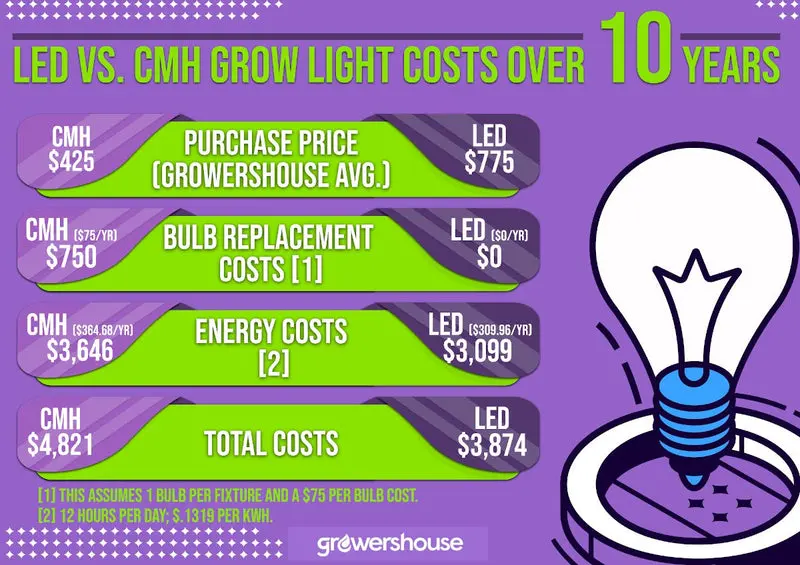
Lisez l'histoireLED grow lights are a bargain in the long run compared with ceramic metal halide lights and fixtures.
Lisez l'histoireChoosing the right grow light technology is one of the most critical decisions for indoor gardening success. The battle between LED and HPS (High Pressure Sodium) grow lights has evolved dramatically, with each technology offering distinct advantages for different growing scenarios. Whether you're a beginner setting up your first grow tent or an experienced cultivator considering an upgrade, understanding the real-world differences between LED an
Lisez l'histoireLED grow lights deliver roughly twice the photosynthetically active radiation (PAR) per watt compared to standard HPS fixtures, making the benefits of LED over HPS commercial grows impossible to ignore in 2026. Top-tier LEDs now hit approximately 3.0–3.1 µmol/J versus 1.7 µmol/J for a 1000W double-ended HPS unit. That gap translates directly into lower electricity bills, better crop quality, and fewer operational headaches. Commercial growers eva
Lisez l'histoireIf you're new to indoor gardening, the jargon surrounding these little lamps can be a bit intimidating. But fear not, my green-thumbed friend! Here are 10 terms to help you understand what all the fuss is about:
Lisez l'histoireLED depreciation, in grower terms, means the gradual loss of usable plant light — measured as PPFD (photosynthetic photon flux density) at the canopy — as your fixture ages. This is not an accounting concept. It is a physical process governed by standards like LM-80 and TM-21 from the IES, tracked by the U.S. Department of Energy, and directly tied to your yield. The single most important action you can take right now is to map your canopy PPFD w
Lisez l'histoireIt has high efficacy and high PAR which rises to 1202 at the hanging height of 12 inches.
Lisez l'histoireIf you are starting to do indoor gardening, there is one thing you have to choose in the first place: How to use light. One of the keys to success in indoor gardening is the right lighting. You must choose between two popular systems: LED grow lights, and HID (high-intensity discharge) grow lights.
Lisez l'histoireThe LED grow light is the fixture that delivers an appropriate amount of usable light across your actual growing area, with acceptable uniformity, heat, controls, electrical demand, and operating cost. Wattage matters because it affects power use and heat, but wattage alone does not describe how much useful light reaches the space. PPF, PPFD, fixture efficacy, a credible PPFD map, and realistic coverage guidance tell you more.
Lisez l'histoireOptics serve two functions—they ensure that the light is directed toward your plants and they increase light intensity. A diode without optics would radiate light in a broad 180° pattern, which would be very inefficient for growing plants since a lot of light would be distributed to the space between the fixture and plants. Optics, whether primary and secondary, are essential for optimal efficiency.
Lisez l'histoireIt is a fact that LED grow lights, which have managed to become an important part of indoor gardening, are becoming more and more popular among indoor growers as they have many advantages over traditional lighting methods such as HID and fluorescent lamps.
Lisez l'histoireThe world of horticulture is undergoing a revolution thanks to the advent of LED grow lights.
Lisez l'histoireHow much money will I save if I switch to LED grow lights? What size LED fixture do I need for my grow tent or grow room?
Lisez l'histoireLED grow light distance gets more important in summer because a room that felt dialed in during spring can suddenly run hotter, dry out faster, and push the canopy harder than expected. The light may not have changed, but the environment around it has.
Lisez l'histoireWhen it comes to nurturing thriving indoor plants, proper lighting is paramount. LED grow lights offer a fantastic solution, mimicking the sun's natural spectrum to fuel your plants' growth. However, one crucial element often overlooked is the distance between the light and your leafy friends. Placing your LED grow light too close or too far can have detrimental effects, impacting growth, development, and even health.
Lisez l'histoireHang a full-spectrum LED grow light at 24 inches above the canopy for seedlings, 18 inches for vegetative plants, and 12–16 inches for mature flowering plants — then fine-tune based on your LED's PPF and dimmer setting. Using a dimmer lets you hang the light 4–6 inches closer without burning leaves.
Lisez l'histoire