To enhance the user experience and extend the lifespan of displays, panel manufacturers and display brands are actively promoting the technological upgrade of W-OLED.
According to TrendForce, in January 2025, LG Display (LGD) launched its fourth-generation W-OLED panel and announced that this type of panel would be used in the monitor industry. In June 2025, LGD announced that it had successfully mass-produced its latest fourth-generation W-OLED monitor panel. In August 2025, LG Electronics (LGE) and GIGABYTE began shipping fourth-generation W-OLED monitors.

In terms of specifications, the latest fourth-generation W-OLED monitors from LG Electronics (LGE) and GIGABYTE are identical. They are 27 inches in size, with a resolution of 2560x1440 and a refresh rate of 280Hz. Thanks to the fourth-generation W-OLED panel, peak brightness reaches 1,500 nits, and the color gamut reaches 99.5% DCI-P3.
In terms of pricing, LG Electronics (LGE) has priced its product at NT$4,599, while GIGABYTE has priced it at NT$2,899. It's clear that GIGABYTE's pricing is more aggressive, closely matching the price of a 27-inch 280Hz QD-OLED monitor.
In terms of technology, the fourth-generation W-OLED panel uses LGD's proprietary Primary RGB Tandem technology, which employs a 4-layer stacked structure (B/G/B/R), while the previous generation used a 3-layer stacked structure (B/Y/B). The adoption of a 4-layer stacked structure can improve the panel's brightness and reduce its power consumption, thus enabling the peak brightness of the fourth-generation W-OLED display to reach 1,500 nits.
Furthermore, replacing the original yellow emissive layer with a red/green emissive layer improves the panel's color gamut, allowing the fourth-generation W-OLED display to achieve a color gamut of 99.5% DCI-P3. It's worth noting that 99.5% DCI-P3 is the highest among existing OLED displays, a level suitable for professional content creation environments such as filmmaking and color grading.
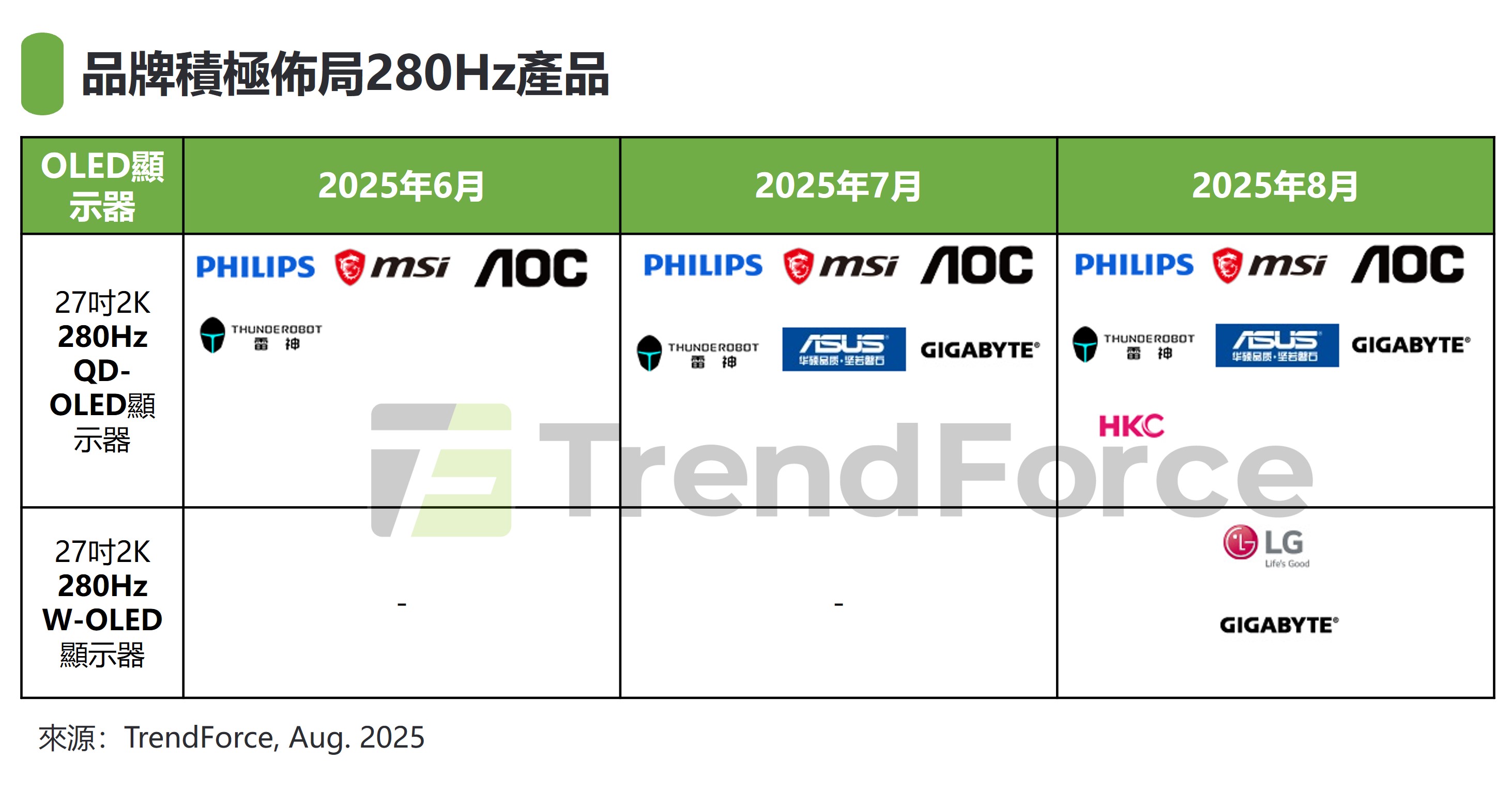
The fourth-generation W-OLED display has a refresh rate of 280Hz, and its release ends the lack of 280Hz products in the W-OLED camp.
According to TrendForce Display, the QD-OLED camp is actively promoting 27-inch 280Hz products to replace existing 240Hz products.
In June, four brands began releasing 27-inch 2K 280Hz QD-OLED monitors: Philips, MSI, AOC, and ThundeRobot. In July, ASUS and GIGABYTE began releasing 280Hz QD-OLED products. By August, HKC also began releasing 280Hz QD-OLED products, and 27-inch 280Hz W-OLED monitors started appearing on the market.
It is estimated that OLED display shipments will reach 2.66 million units in 2025, representing an 86% year-on-year increase, with a penetration rate of approximately 2% in overall display shipments. This growth momentum is expected to continue in the coming years, with the penetration rate potentially rising to 5% by 2028. (TrendForce Display Fandy)


