In recent years, with the continuous growth of market demand for display products, iLED (inorganic light-emitting diode) display technology has gradually become the leading force in the transformation of the display industry. It is being rapidly applied in fields such as televisions, large-size direct-view screens, automotive displays, and AR/VR, driving the continuous evolution of display technology.
What is the current state of development of multi-dimensional iLED display technology? In which applications and markets will future opportunities lie?
At the 2024 TrendForce Self-Emitting Display Industry Seminar, Chiu Yu-Bin, Senior Vice President of Research at TrendForce, provided a comprehensive analysis, starting with Mini LED backlighting/direct display, Micro LED (glass-based and silicon-based), and quantum dot self-emissive technologies, and explored the market application potential and future development trends of diverse iLED technologies.
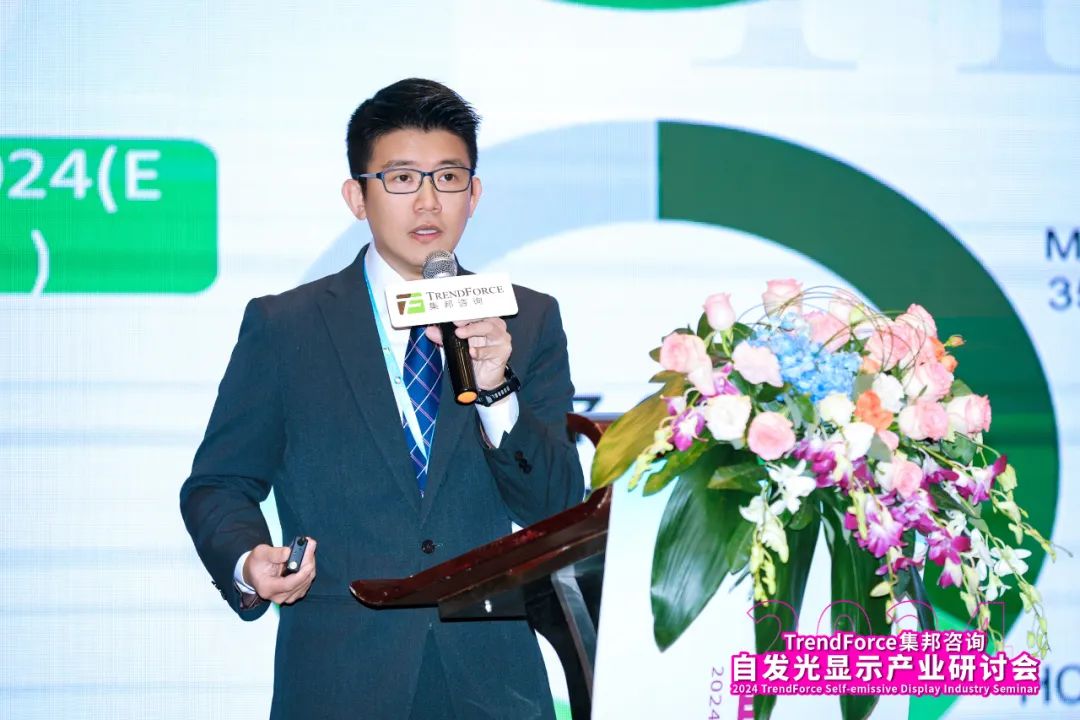
Chiu Yu-Bin, Senior Vice President of Research at TrendForce
Mini LED backlighting is rapidly penetrating the TV and automotive display markets . Mini LED backlighting technology, with its advantages of high brightness and high contrast, has gradually become popular in high-end markets such as TVs and automotive displays, and market acceptance is rapidly increasing. In the TV sector, in recent years, Mini LED backlighting has benefited from technological innovations such as adjustments to PCB structure, increased chip voltage, and active driving, resulting in a rapid decrease in cost. TV brands have also increased their investment in Mini LED backlit TV products. Therefore, Mini LED backlighting has stood out in the consumer TV market and quickly captured a certain market share.
TrendForce predicts that by 2028, global Mini LED TV shipments are expected to exceed 26 million units, accounting for approximately 13% of the total.
In the automotive display sector, the demand for Mini LED backlighting is also growing. Overseas automakers in Europe and South Korea generally recognize that Mini LED backlighting brings better HDR and contrast effects, so the adoption of Mini LED backlighting in vehicles is gradually accelerating.
Although the penetration rate of Mini LED backlighting in the automotive display sector was still low in 2024, TrendForce predicts that by 2028, with automakers in various countries reaching a consensus on the acceptance of Mini LED backlighting, the penetration rate of Mini LED backlighting in the automotive sector will reach 6%, or 15 million units shipped, representing a tenfold increase compared to 2024.

Mini LED Displays: Small Pitch Specifications Unleash Multi-Scenario Applications <br /> In the future, Mini LED displays (Mini LED direct display screens) will show strong growth momentum in the large-size display market. Their applications are not limited to commercial displays, but they also have irreplaceable appeal in some consumer markets.
Especially with the rise of the ESG concept globally, society has become more concerned about energy consumption. In the field of large-size displays, Mini LED has a leading advantage in energy consumption. Compared with LCD and OLED, Mini LED displays have higher system efficiency (approximately 4%-7%). The advantages in system efficiency and energy saving have laid an important foundation for the development of Mini LED displays in the ultra-large-size field.
In terms of production capacity, COB capacity has expanded 2.7 times in the past two years, reaching 57,600 square meters per month. This means that Mini LED displays have ample production capacity, driving a continuous decline in their prices. According to TrendForce's market price research, the price per square meter of some all-in-one displays is gradually approaching that of LCDs, allowing Mini LED displays to gain a larger market share in the large-size display sector in the future.
In terms of applications, in addition to traditional commercial displays, home theaters, virtual shooting and other applications are directions worth paying attention to in the future development of Mini LED displays.
In the home theater field, Mini LED displays significantly outperform traditional projectors in grayscale performance and response speed. In virtual filming, Mini LED displays can significantly enhance the immersive experience of shooting by replacing green screens; although the initial cost is higher than green screens, it can significantly reduce post-production costs in the long run.
Cinema screens are another emerging application worth paying attention to. Currently, approximately 160 high-end Mini LED cinema screens have been installed globally, and the penetration rate is expected to increase further in the future. As a major supplier and consumer of Mini LED displays, the Chinese market is poised to become a demonstration market for high-end Mini LED cinema screens.
Based on an analysis of energy efficiency, production capacity, price, and applications, TrendForce predicts that the market value of Mini LED small-pitch LEDs with a P2.5 or less will increase from the current level of US$4.5 billion to US$6.9 billion in 2028, with a compound annual growth rate of approximately 10%.
The development of Mini LED ultra-small pitch below P1.0 is the fastest growing area. With the opening of the indoor and high-end application markets, its market value will grow from US$382 million in 2024 to US$1.092 billion in 2028, with a compound annual growth rate of about 28%.

Glass-based Micro LED technology innovation drives automotive applications
Micro LED technology is one of the most important breakthroughs in the display industry in recent years. Although Apple delayed its Micro LED watch product due to cost and technical reasons, other manufacturers in the industry are still actively investing in Micro LED technology.
Meanwhile, significant progress has been made in the miniaturization technology of Micro LED chips, with chip size gradually shrinking from the current 34×58 micrometers to 15×30 micrometers. This will greatly increase the number of chips per wafer and improve cost-effectiveness. Various mass transfer solutions, such as stamp transfer, laser transfer, and fluid self-assembly, are also gradually maturing in the market, providing diverse options for downstream applications of Micro LED.
On the other hand, the detection solution remains a key bottleneck that needs to be overcome in the development of Micro LED. There are currently a variety of solutions, and it is believed that non-contact electrical detection is likely to become a more effective direction for solving the detection problem of Micro LED in the future.
With continuous technological advancements, Micro LED has made significant progress in large-size commercial display applications, and the next step for Micro LED development will focus on the automotive display field. Micro LED's high brightness and low pixel fill rate make it suitable for use in automotive center consoles, instrument clusters, AR HUDs, and transparent displays.
Based on the above factors, TrendForce predicts that the output value of Micro LED chips will reach US$600 million by 2028.

LEDoS: The Future of Near-Eye Display
Silicon-based Micro LEDs (LEDoS) are considered ideal for next-generation AR head-mounted displays due to their small size and high luminous efficiency. Qiu Yubin stated that the emergence of silicon-based Micro LEDs has brought new vitality to the LED industry, providing a completely new technological development blueprint. For example, silicon differs from traditional sapphire or gallium arsenide in the choice of backplane; and in terms of manufacturing processes, chip bonding offers a wide variety of options, giving the industry numerous technological pathways to explore the potential of silicon-based Micro LEDs.
As a technology still in its early stages of development, silicon-based Micro LED faces challenges in areas such as wafer size, micro-optical structure, and full-color capabilities. However, as the technology matures, the small size and high luminous efficiency of silicon-based Micro LED will meet the needs of AR head-mounted devices. TrendForce predicts that by 2030, silicon-based Micro LED has the potential to account for over 30% of the AR market, becoming the only mainstream technology in this field.

Quantum Dot Self-Emitting (QDEL) Will Become the Ultimate iLED Display Technology <br /> What will the final form of iLED display technology look like in the future? Qiu Yubin believes that quantum dot self-emissive (QDEL) will be the ultimate solution for inorganic LEDs.
QDEL (Quantum Dot Electrode) can achieve self-illumination without an external light source. Compared with traditional quantum dot films and quantum dot color filters, QDEL has significant advantages such as high color saturation, low power consumption, and long lifespan. However, current quantum dot self-illuminating technology still faces challenges in terms of material consistency and efficiency. Leading global display manufacturers such as Samsung Display and CSOT (China Star Optoelectronics Technology) have launched quantum dot self-illuminating products using printing technology. Although they excel in color saturation and power consumption, disagreements remain regarding material selection.

To achieve widespread adoption of QDEL in the display field, the industry must overcome key challenges such as material environmental friendliness, production costs, and recyclability. Driven by technological advancements and industry efforts, quantum dot self-emissive technology is expected to bring new growth opportunities to the high-end display market and provide new impetus for future innovation in the LED display industry.


