Recently, Toyoda Gosei Corporation of Japan has made significant progress in the field of monolithic full-color Micro LED displays. They achieved red, green, and blue (RGB) tri-color emission using stacked indium gallium nitride (InGaN) materials, paving the way for future high-brightness, miniaturized display technologies.
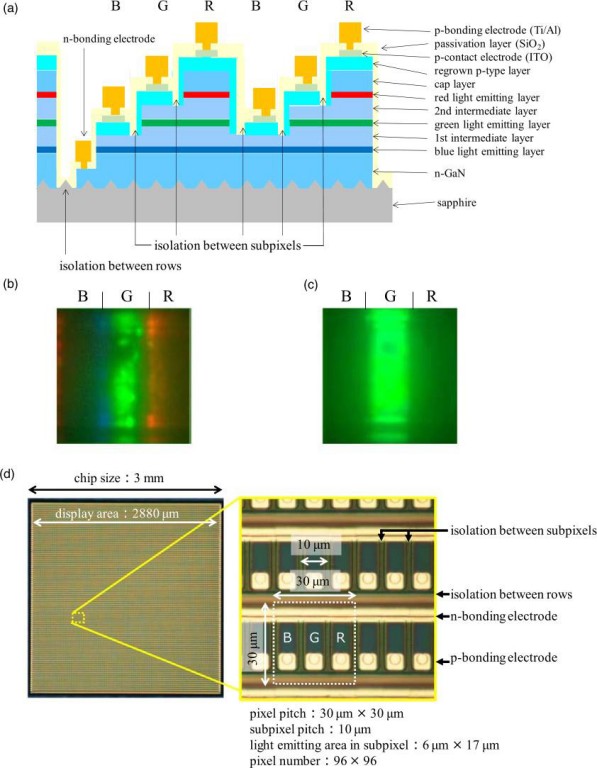
Figure 1. (a) Schematic cross-sectional structure of the full-color monolithic Micro-LED developed by Toyoda Gosei. (b) Electroluminescent (EL) image of subpixels without subpixel spacing design. (c) EL image of subpixels with subpixel spacing design. (d) Photograph of the monolithic Micro-LED chip developed by the researchers.
It is understood that most microdisplays currently on the market use OLED technology, but their lower brightness limits their application in outdoor settings or augmented reality (AR) glasses. InGaN Micro LEDs, on the other hand, not only offer higher brightness but also simplify the manufacturing process through single-chip integration. Although the material regeneration process used by the team increases manufacturing complexity, it is more compatible with semiconductor manufacturing processes and has greater industrialization potential compared to methods such as quantum dots or tunnel junctions.
The research team used metal-organic chemical vapor deposition (MOCVD) technology to grow Micro LED chips on a sapphire substrate and achieved pixel separation through steps such as etching and electrode deposition. Ultimately, they fabricated a 96×96 pixel microdisplay with a total size of only 3mm × 3mm, suitable for small display devices.
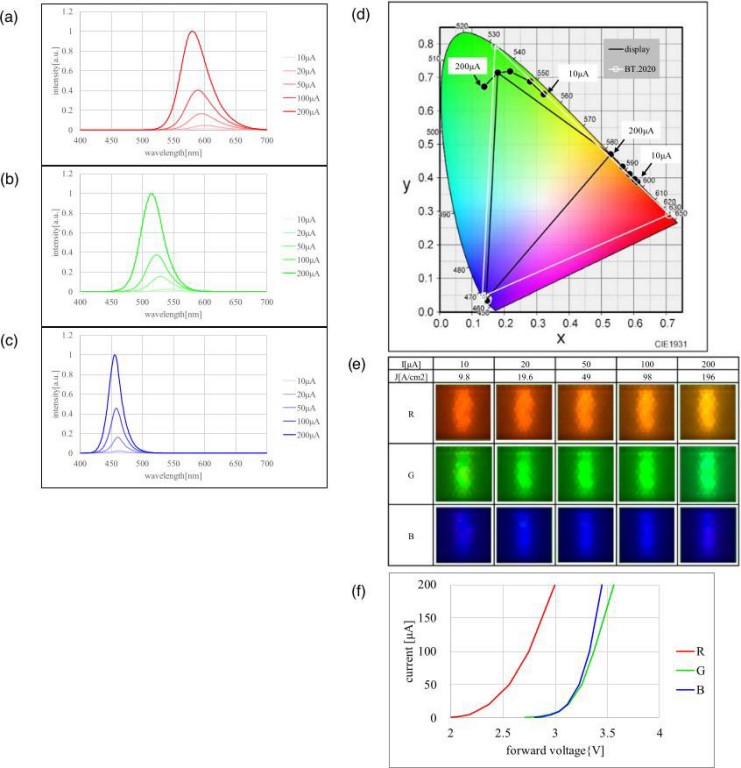
Figure 2. (a)-(c) show the electroluminescence spectra of the red, green, and blue sub-pixels when the driving current is between 10-200 μA. (d) shows the color reproduction capability of the display based on monochrome Micro-LEDs as shown in the chromaticity diagram. (e) shows the electroluminescence images of three monochrome Micro-LED devices. (f) shows the current-voltage characteristics of the three different color sub-pixel Micro-LEDs.
In the tests, the RGB three-color pixels performed stably under different currents, but the efficiency of the red pixels was low, at only 0.2%, far lower than that of green (2%) and blue (3%). Furthermore, the display's color gamut coverage was only 69.9% of the NTSC standard, lower than the team's previous achievement of 95.4%, mainly due to the shorter wavelength of the red light from the Micro LED. However, the researchers stated that this problem can be improved by optimizing the red emitting layer.
The team also successfully played a 4-bit grayscale full-color image using this miniature display and optimized color performance through pulse width modulation (PWM) technology. Although there are still issues such as low red brightness and some areas around the chip not emitting light, these technical challenges are being gradually addressed.
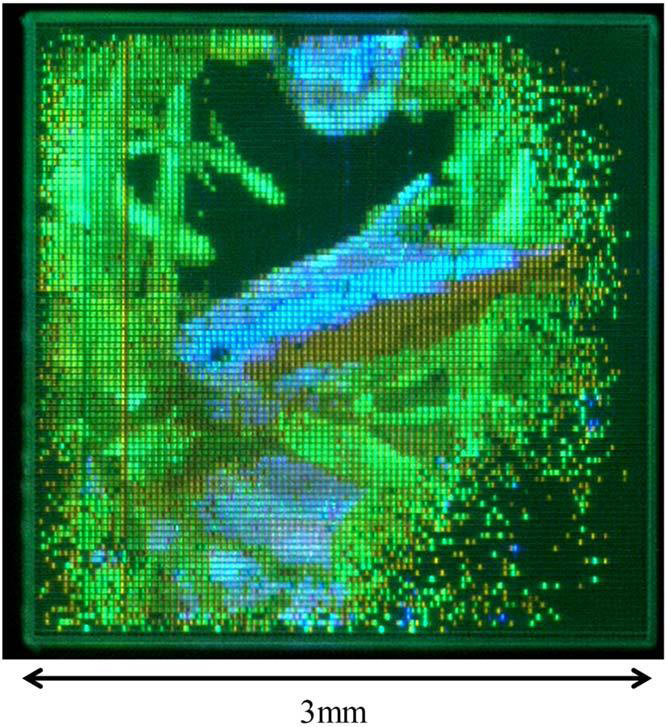
Figure 3. Display image of a monolithic Micro LED array
In the future, this technology is expected to be applied to fields such as AR glasses, virtual reality (VR) devices, and high-resolution electronic viewfinders, driving the development of microdisplays towards higher brightness and wider color gamut. (Translated by Irving)


