Recently, Lumileds announced a breakthrough in its latest Micro LED technology in collaboration with Eindhoven University of Technology (TU Eindhoven).
A joint research team has significantly improved the light emission directionality and efficiency of Micro LEDs by integrating metasurfaces at the chip level. This technology is expected to have broad prospects in various LED applications, potentially significantly improving the brightness of Micro LED displays and enabling more efficient optical coupling in applications such as AR and data communication. This research was published on April 6th in the journal *Nature Communications Engineering*.
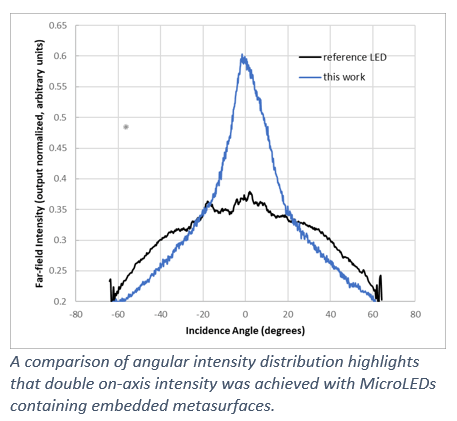
Micro LEDs with integrated metasurfaces achieve a doubling of axial luminous intensity (Image credit: Lumileds).
Lumileds explained that researchers embedded a metasurface composed of nanoscale disks in the p-contact layer of Micro LEDs, and enhanced the external coupling efficiency and radiative recombination efficiency of light by exciting the collective resonance of emitting dipoles in the active region, thereby significantly improving the overall efficiency of the LED.
Furthermore, the research team modulated the far-field emission mode of LEDs by designing a novel nanostructure array. The team successfully demonstrated that, with comparable LED output power, the axial brightness (in candela) could be doubled.
Toni Lopez, a scientist in Lumileds' R&D department, explained that for applications such as AR and data communication, the Lambertian emission mode of traditional LEDs is too dispersed, which is not conducive to efficient coupling with secondary optical components and also limits the brightness performance of direct-view displays under high ambient light conditions. To overcome these limitations, the team turned to the research of nanophotonics technology, thus achieving this new technological achievement. (Compiled)


