At a critical juncture when near-eye display technology is rapidly moving towards large-scale application, JBD, through continuous technological innovation, has successfully reduced the number of dead pixels in MicroLED microdisplays from ≤100 per screen to ≤3. This breakthrough not only signifies that MicroLED microdisplays have reached the quality control standards of mature display technologies such as LCD, but also sets a new benchmark for dead pixel indicators in the MicroLED microdisplay industry.
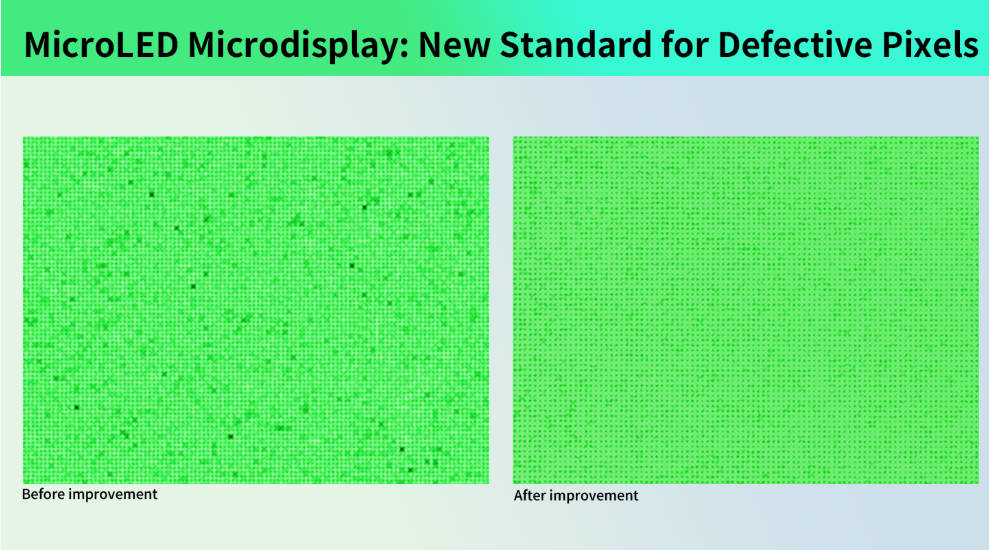
A New Standard in Defect Pixel Control <br /> The number of dead pixels and dark pixels has always been a key indicator for measuring the reliability and technological maturity of MicroLED microdisplay products. Previously, limited by technological level and manufacturing processes, the industry generally faced a technical bottleneck of nearly 100 dead pixels per screen, which to some extent hindered the widespread application of consumer-grade AR terminals. To break through this technological constraint, JBD has continuously deepened its research on core MicroLED microdisplay technologies in recent years, reducing the number of dead pixels in microdisplays to ≤3 per screen, with a significant increase in the proportion of perfect screens with 0 dead pixels.
Moreover, dark spots are another long-neglected technical challenge in the MicroLED microdisplay field, directly affecting image uniformity and imaging quality. Through technological upgrades, JBD has reduced the dark spot rate per screen from as high as 0.4% to an extremely low level of 0.03%, and combined with JBD's unique Demura pixel brightness compensation algorithm, has significantly improved pixel brightness uniformity.
Dead pixels and dark spots have a significant impact on display quality and user experience. Dead pixels form noticeable black spots in an image, compromising image integrity and detail; dark spots cause dullness and imperfections, affecting color accuracy and image uniformity. These defects are particularly noticeable in high-contrast or bright scenes, easily distracting users and reducing visual immersion. Reducing dead pixels and dark spots can effectively avoid problems such as image fragmentation, dull and distorted colors, and significantly improve image integrity and uniformity, playing a crucial role in enhancing the visual quality of AR near-eye display scenarios.

Comprehensive improvement of technology, processes, and equipment management
Improving the quality control standards for dead pixels and dark pixels in micro displays is a complex and systematic project. The aforementioned breakthroughs are due to JBD's continuous investment and collaborative efforts in technology iteration, process optimization, defect analysis, and lean management.
Technically, JBD achieves uniform material density distribution by improving the epitaxial structure. Simultaneously, innovative processes ensure pixel-level uniform actuation. In terms of equipment and manufacturing, advanced equipment has been introduced to improve processing precision. Regarding production management, inspection procedures have been added to each process step, with strict monitoring and precise control of key processes to ensure the entire production process meets the highest quality standards.

This not only reflects JBD's technological innovation and significant improvements in manufacturing processes, but also signifies that MicroLED microdisplays are entering a mature stage of application. With the rapid development of AI technology, the demand for lightweight AR glasses as all-weather AI assistants is growing. MicroLED microdisplay technology, with its superior performance in high brightness, small size, and low power consumption, is gradually becoming the preferred solution for lightweight AR glasses. Significant improvements in dead pixel and dark pixel control will further solidify JBD's advantages in near-eye display scenarios.
Standing at a crucial juncture as consumer-grade AR smart glasses move towards widespread adoption, JBD remains committed to creating high-performance, reliable microdisplay products for its customers. Looking to the future, JBD will delve deeper into MicroLED microdisplay technology, continuously increasing R&D investment to drive the industry forward and lead it to new heights.