On June 3, it was reported that Xie Rongjun, Huang Kai, Xuan Tongtong, and others from Xiamen University demonstrated green and red quantum dot luminescent microspheres, which simultaneously possess high color conversion efficiency and excellent PL stability, thus achieving ultra-efficient and bright RGB Micro LEDs.
Micro LED is characterized by ultra-high resolution, ultra-high brightness, fast response speed, high contrast, and low power consumption.
However, in the process of miniaturizing traditional inorganic III-V semiconductor LEDs to the microscale (≤50µm), they face technical and performance challenges such as a sharp decline in the radiation efficiency of green and red LEDs, difficulties in mass transfer, and mismatch in the driving voltage of red, green and blue (RGB) pixels, which seriously affect their commercialization process.
To address these issues, nanoscale-sized, high-efficiency, narrow-band emission, and high-color-purity red and green quantum dots (QDs) are used as color conversion materials and combined with blue micro-LEDs to achieve full-color micro-LED displays. This method promises to simplify mass transfer, facilitate driving circuitry, and reduce costs.
However, due to the low extinction coefficient of quantum dots in the blue region, the light extraction efficiency (LEE) of quantum dots is poor, resulting in severe blue light leakage and low luminous efficiency in the quantum dot-converted micro LEDs. Therefore, the performance of quantum dot color conversion layers (CCLs) remains low.
Recently, blue light leakage has been effectively suppressed by embedding quantum dots into nanoporous GaN and adding color filters (CF) or distributed Bragg reflectors (DBR) to the device to absorb or reflect residual blue light that the quantum dots cannot absorb.
However, these methods inevitably increase power consumption, reduce viewing angle, and increase the surface temperature of the micro-LED display. Furthermore, for traditional QD displays, the QD CCL is sandwiched between two water-oxygen barrier layers up to 260 micrometers thick to improve display reliability. This strategy is unsuitable for micro-LEDs because the aspect ratio would increase significantly, making it difficult to form patterns with small pixels (<50µm).
While thinner and more stable quantum dot pixels can be prepared by coating with silicon dioxide, aluminum oxide, or siloxane ligands without using a water-oxygen barrier layer, thereby improving the PL stability of quantum dots, the color conversion performance of quantum dots is greatly reduced and nonradiative recombination is increased due to the damage to the quantum dot surface caused by silane hydrolysis, surface ligand modification, or atomic layer deposition (ALD) and the low blue absorption rate.
Therefore, constructing quantum dot materials that simultaneously possess excellent color conversion efficiency and excellent PL stability is key to realizing highly reliable full-color micro LEDs.
Dendritic mesoporous silica spheres (DMS) possess characteristics such as adjustable diameter, abundant mesopores, high refractive index, excellent optical transmittance, and strong chemical stability. Therefore, encapsulating quantum dots within the mesopores of DMS can improve the color conversion performance and reliability of quantum dots.
The spatial confinement of the mesopores reduces reabsorption in quantum dots, allowing them to be separated from water and oxygen. Furthermore, the optical microcavities formed between the mesopores and the filler improve the local optical field for excitation and emission light. However, several key issues need to be addressed, such as i) how to suppress organic ligand shedding and reduce damage to the quantum dot surface during sealing; and ii) how the encapsulation structure affects color conversion performance.
The research team synthesized cadmium-based QD@dMS@polymaleic anhydride octadecene (PMAO)@SiO2 (QD@dMS@PMAO@SiO2) luminescent microspheres with an average diameter of 220 nm using a wet process, in which PMAO serves as a bridge between the quantum dots and the SiO2 shell. PMAO can not only inhibit ligand desorption but also inhibit the hydrolysis of 3-aminopropyltriethoxysilane (APTES), thereby destroying the surface of the quantum dots.
The results show that the microspheres possess high external photoluminescence quantum efficiency (EQY) and excellent photoluminescence stability against blue light, heat, and water oxygen. Combining finite-difference time-domain (FDTD) analysis with the experimental results reveals the mechanism for improved color conversion performance. Finally, the maximum external quantum efficiency (EQEs) of the green and red microLEDs reached 40.8% and 22.0%, respectively. These were further integrated with a thin-film transistor (TFT) backplane to realize a microLED display with high pixel resolution and high brightness.


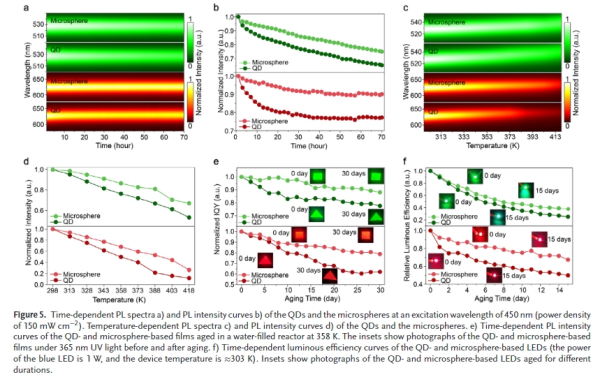


(Source: Future Display Technology Research Institute)