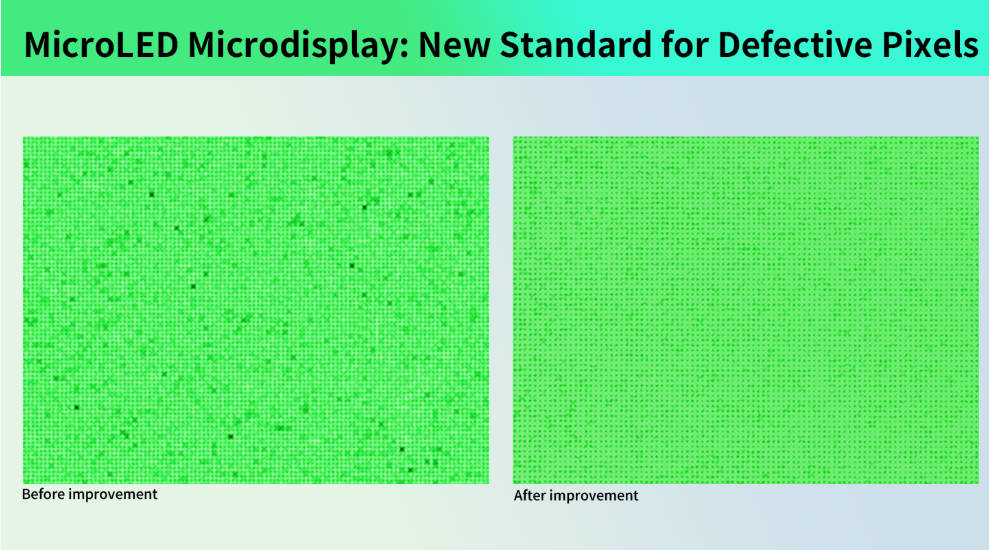
On July 22, Q-Pixel, an American Micro LED display technology startup, released its latest mass transfer technology, Q-Transfer. The new technology achieves a transfer yield of over 99.9995%, far exceeding traditional mass transfer methods.

Image source: Q-Pixel
Q-Pixel showcased a prototype Micro LED display panel manufactured using Q-Transfer technology. This panel employs 10μm tunable polychromatic LED (TP-LED) pixels, achieving a high-density display effect of over 500 pixels per inch (PPI). During the Micro LED transfer process, no pixel loss occurred, demonstrating a transfer yield exceeding 99.9995%.
Q-Pixel stated that the launch of Q-Transfer technology is a key milestone in the company's development. Q-Transfer technology brings a simpler and more cost-effective Micro LED solution to the display industry, unlocking the potential of Micro LED and expanding beyond the AR/VR market to include smartwatches, smartphones, and other large-screen devices.
It's worth noting that Q-Pixel has previously released several high-definition Micro LED display products, including its self-developed world's highest resolution full-color active matrix display (6800 PPI) and a passive 10000 PPI Micro LED display made with the world's smallest full-color pixels (only 1 micrometer in diameter). With breakthroughs in mass transfer technology, Q-Pixel is expected to launch more high-definition full-color Micro LED display products in the future.
Breakthroughs continue in mass transfer technology. <br /> Mass transfer is one of the challenges in the industrialization of Micro LED. How to transfer millions or even tens of millions of micron-sized LED chips from the growth substrate to the driver backplane at high speed, with precision and low cost has been a long-standing challenge for the industry.
However, as time goes by, the problem of mass transfer is being gradually overcome. Companies are continuously improving the yield of mass transfer through different solutions, accelerating the mass production process of Micro LED.
Besides Q-Pixel, many domestic LED and display companies are also making continuous breakthroughs in the challenge of mass transfer.
In the LED field, in April of this year, Leyard released its new generation of Hi-Micro technology, which is built using a self-developed laser mass transfer process, improving transfer efficiency and system stability.
Unilumin Technology has overcome the challenges of mass transfer technology by deploying MiP packaging technology, achieving substrate-free 0202 packaging of Micro LEDs with a size of 30 μm*50μm, and simultaneously realizing the mass production of MiP P0.4 pitch display products.
Nationstar Optoelectronics is actively researching cutting-edge Micro LED technologies. By focusing on the bottleneck problem of Micro LED mass transfer technology, it has developed a planar hot-pressing mass bonding process to achieve high-precision, high-density electrical connection between Micro LED chips and substrates, ensuring that Micro LED products achieve high resolution, high brightness, and high color saturation display characteristics.
At the end of last year, Chenxian Optoelectronics released its new generation of TFT-based Micro-LED splicing screens, which use Micro-LED chips with a size of only 25 micrometers. Through internationally leading mass transfer and repair yield of 99.995%, the screen is equipped with 33 million LEDs (88-inch P0.5 product). Chenxian Optoelectronics stated that the mass transfer and repair solution has reached the mass production preparation stage.
Shenzhen Konka primarily supplies 4-inch and 6-inch Micro LED epitaxial products. Konka previously stated that its hybrid mass transfer technology has achieved a yield of 99.999%, and its products can be applied to smart wearables, AR/VR, automotive, and large-screen displays.
Besides LED manufacturers, many panel manufacturers are also actively developing Micro LED technology. Therefore, these companies are also key players in helping to overcome the challenges of mass transfer.
For example, BOE is simultaneously developing RGB Mini/Micro LED direct-view solutions based on COG (Chip-on-Glass) and COB (Chip-on-Board) technologies, as well as Mini LED backlight solutions. Previously, BOE had collaborated with international equipment companies to develop mass transfer technology and completed the construction of its 2.5th generation mass transfer pilot line.
TCL CSOT and Sanan Optoelectronics have established a joint venture, Chipwin Display, which focuses on four major technological breakthroughs: LED chip miniaturization, luminous efficiency improvement, transfer bonding technology development, backplane material process research, and driving and compensation algorithm optimization.
At the end of last year, Shenzhen Tianma completed the commissioning of its G3.5 generation Micro LED production line. This production line utilizes LTPS TFT glass substrates and advanced all-laser mass transfer technology to produce Micro LED display products with no size limitations and frameless splicing capability.
AU Optronics has invested in research and development of key Micro LED processes, particularly mass transfer technology, and has developed its own solutions to improve production efficiency and yield...
Summary <br /> Currently, both domestic and international companies are making the latest strategic deployments in key Micro LED manufacturing processes, continuously advancing research on challenging technologies such as mass transfer. Against this backdrop, breakthroughs in the industrialization challenges of Micro LED are expected to accelerate once again. (Text: Irving)