On the morning of October 13, the groundbreaking ceremony for the New Display Industrial Park in Nanchong City, Sichuan Province, was held, marking the official commencement of construction on the HKC full-color M-LED new display chip base project.
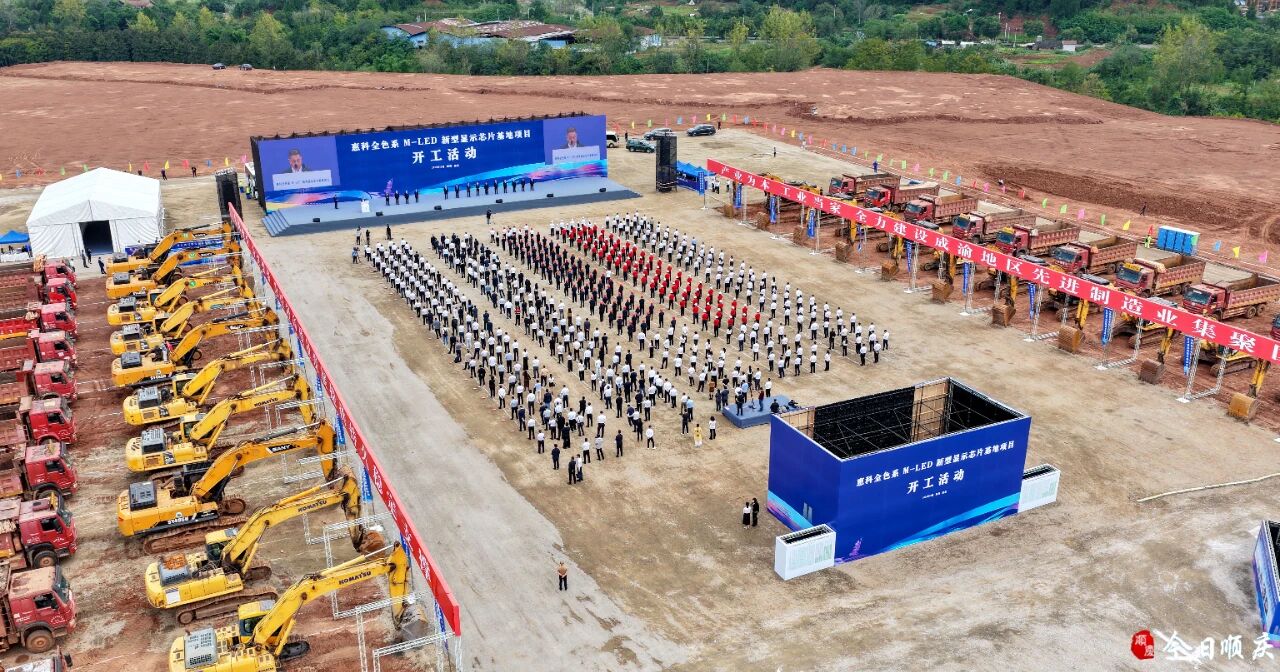
Image source: Shunqing Today
It is reported that the project was signed in May this year, with a total investment of 10 billion yuan and an area of about 500 mu. The overall plan is to build in three phases, with a designed total monthly production capacity of 1 million pieces. The core focus is on the research and development and production of full-color M-LED new display chips.
The first phase of the project plans to construct 134,500 square meters of standardized factory buildings, including the main factory buildings for epitaxial growth and chip manufacturing, as well as supporting facilities such as power supply area, employee dormitory and canteen; the project is designed to have a monthly production capacity of 150,000 wafers and is scheduled to be put into production in June 2026.
HKC's multi-track approach is fraught with challenges . HKC's large-scale investment in MLED technology is influenced by changes in the industry landscape and also reflects its own development ambitions.
HKC's main business is LCD panels. After years of rapid development, the industry has entered a mature stage. Technological barriers have decreased and the market is becoming saturated, resulting in compressed profit margins. In addition, HKC faces competitive pressure from companies such as BOE and TCL CSOT in the LCD field.
Taking TCL CSOT as an example, on April 1st of this year, LG Display's Guangzhou LCD 8.5-generation line was officially handed over to TCL CSOT and renamed T11. It is pointed out that through mergers and acquisitions and the capacity expansion of the T9 8.6-generation line, TCL CSOT's share of global LCD large-generation line (5th generation and above) capacity is expected to grow.
In order to escape the fierce competition in the LCD market, HKC is actively developing new display technologies with development potential, such as MLED and OLED. However, this path is also full of challenges.
In the MLED field, the competition is fierce, with rivals including panel manufacturers such as BOE, TCL CSOT, Tianma, Innolux, and AUO, as well as companies deeply involved in the LED display field such as Leyard, Unilumin, and Lehman Optoelectronics.
In the OLED field, BOE has already built multiple high-generation OLED production lines in Chengdu, Mianyang, and Chongqing, and plans to further increase its capacity through the construction of new lines. TCL CSOT is focusing on printed OLEDs, and in September of this year announced an investment of 29.5 billion yuan to build the world's first 8.6-generation printed OLED display panel production line in Guangzhou, which is expected to start construction in November. This poses a challenge to HKC.
In this competitive landscape, diversifying its business has become one of HKC's options.
HKC Accelerates Expansion of New Display Technologies <br /> To achieve breakthroughs, HKC has made significant investments this year in new display technologies such as MLED, OLED, and electronic paper.

In the field of MLED, HKC launched three key projects in the first half of this year: the first phase of the Mianyang HKC Mini LED project, the Changsha, Hunan HKC Mini LED backlight/direct display module and complete machine project, and the second phase of the HKC Dongguan flat panel display project. The total investment of the three projects reached RMB 14.76 billion.
In terms of products, HKC showcased several Mini LED backlit TVs at the DIC exhibition in August this year, including the world's first 116-inch 4K ultra-thin wallpaper TV and a 116-inch RGB Mini LED backlit TV jointly developed with Hisense.
In the OLED sector, HKC acquired some assets of Royole Technology's flexible display industrial park in Shenzhen for approximately RMB 504 million in January this year, including the G5.5 flexible OLED production line and oxide TFT technology. This move is seen by the industry as a key step for HKC to quickly enter the OLED field. HKC will leverage Royole's legacy technology to enhance its own strength.
In July of the same year, HKC's first self-developed and manufactured OLED module was lit up at the HKC Innovation Semiconductor Display Industrial Park in Shenzhen. This mass-produced OLED module overcame core process barriers, filled the gap in HKC's OLED field, and helped HKC build a full-application scenario product system covering LCD, Mini LED to OLED, and from small size to large size.
In the field of e-paper, in April this year, HKC signed an e-paper display module assembly project in Chuzhou, Anhui Province, with a total investment of approximately 8 billion yuan. In May, HKC's e-paper production base in Guizhou Province officially started production, with a total investment of 5.5 billion yuan. At the same time, HKC also officially signed a joint development agreement with E Ink Holdings, focusing on tackling the research and development and large-scale mass production of large-size e-paper.
On the product side, on July 28th, HKC's own brand Sambada launched a 7-inch 300PPI high-definition e-paper reader. This product uses an E Ink Carta 1300 e-ink screen with a resolution of 300PPI.
Large-scale production line construction requires financial support; therefore, HKC is actively seeking a listing to open up financing channels. Latest news indicates that HKC's main board IPO has been suspended due to outdated financial information in its application documents. However, this is a procedural suspension, and the IPO process can resume as long as the missing information is submitted in time.
Regarding panel manufacturers' strategies in the LED display field, you can pay attention to the 2025 Self-Emitting Display Industry Seminar to be held in Shenzhen on October 30 by its subsidiary, TrendForce Display. At that time, 13 representative companies in the display industry will discuss related topics in depth and work with industry players in the display field to shape a new landscape.