In 2025, the near-eye display industry will enter a new stage of development. In this year, lightweight AI+AR display glasses will accelerate their entry into the consumer market. With the empowerment of AI, the application of AR glasses will no longer be limited to the entertainment field, but will expand to vertical fields such as office, industry, and medical care, and gradually develop into a new productivity tool.
With the changing application scenarios, AR glasses have placed higher demands on near-eye display technology. Currently, the main near-eye display technologies of mainstream manufacturers include LCoS, LEDoS, and OLEDoS. This article will focus on OLEDoS technology and analyze its current development status and future trend from the perspectives of capital investment, industrial infrastructure, and new terminal products.
Continued capital injection fuels the development of OLEDoS microdisplay technology . This year, companies such as VITURE, Xitai Technology, Visionox, Xinshijia, Fläte, and Hongxi Technology have made new progress in the capital market. With the support of capital, the OLEDoS industry is entering a faster development phase.

Regarding its IPO, in June of this year, the Shanghai Stock Exchange accepted Visya's IPO application, and in July, the IPO status was changed to "under inquiry," entering the formal review stage. The prospectus shows that Visya plans to raise 2.015 billion yuan in this listing, which will be used for the expansion of its ultra-high resolution OLEDoS micro-display device production line and the construction of a research and development center to support capacity upgrades and technology optimization.
In terms of financing, from the perspective of the industrial chain, the companies that have received financing are involved in OLEDoS micro-display devices, supporting equipment manufacturing, and terminal brand layout, showing a trend of coordinated development across the entire industrial chain.
In the field of OLEDoS microdisplay devices, Hongxi Technology completed a 500 million yuan Series A financing in February, Xinshijia completed a 600 million yuan Pre-A round financing in June, Xitai Technology obtained a 150 million yuan Series B financing in August, and Yunguang Technology completed a Series A financing in December. All four companies have set up 12-inch OLEDoS production lines, and the financing funds have been used for production line construction and market expansion.
On the equipment manufacturer side, Flate completed a pre-A round of financing worth tens of millions of yuan in April this year. Its business covers high-end wet cleaning equipment in fields such as OLEDoS. The funds will be mainly used to further promote its localization research and development and manufacturing of wet cleaning equipment, so as to support the company to achieve large-scale mass production and delivery.
On the terminal manufacturer side, VITURE, founded by former Google and Apple employees, completed two additional rounds of Series B financing in September this year, totaling $100 million. The funds will be mainly used for three aspects: first, to accelerate the layout of global retail channels; second, to promote the application of enterprise-level productivity and collaboration scenarios; and third, to continue to invest in the research and development of the XR ecosystem.
12-inch OLEDoS projects emerge, and domestic companies accelerate development . With capital in place, large-scale infrastructure construction has begun. In addition to the companies mentioned above—Xitai Technology, Hongxi Technology, Xinshijia, and Yunguang Technology—Weichuangda, Guozhao Optoelectronics, Yirui Technology, and Ruixian Technology have also announced progress on their OLEDoS-related projects this year.
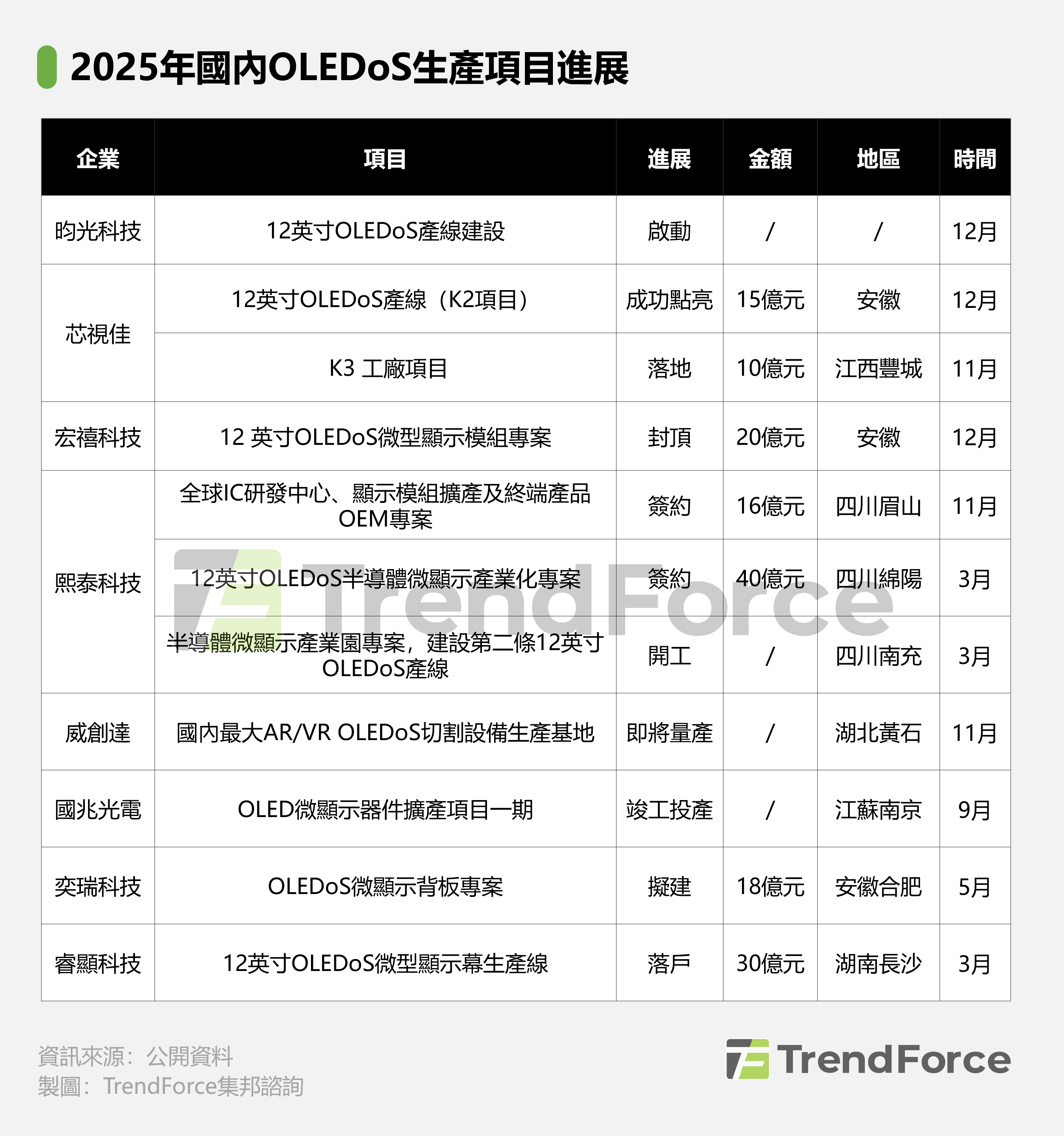
Specifically, Xitai Technology has advanced three projects this year. In March, Xitai Technology signed agreements for a 12-inch OLEDoS production line in Mianyang and Nanchong, Sichuan Province, with the Mianyang line representing an investment of 4 billion yuan. In November, Xitai Technology launched the second phase of construction in Meishan, a project related to the advancement of its second 12-inch OLEDoS production line. This project aims to strengthen its independent IC R&D capabilities, expand the scale of module and complete machine manufacturing, and extend its optomechanical module and complete machine OEM business.
In March of the same year, Ruixian Technology also announced that its 12-inch OLEDoS micro-display production line had officially settled in Changsha Jinxia Economic Development Zone. The project has a total investment of 3 billion yuan and will rely on the existing 8-inch mass production base to create an industrial base integrating R&D, production and sales, promote the synergy of "8+12 inches" dual lines, and meet the needs of multiple AR/VR/XR scenarios.
In April, Hongxi Technology's 12-inch OLEDoS project broke ground, and in December it was officially topped out. The project represents an investment of 2 billion yuan and, upon reaching full capacity, will have an annual production capacity of 72,000 12-inch wafers. It is understood that Hongxi Technology has already built one 12-inch OLEDoS production line and launched products in multiple sizes; it is currently developing a new 1.4-inch model.
In the second half of the year, the first phase of Nanjing Guozhao Optoelectronics' OLED micro-display device expansion project was completed and put into operation in September. The project has a total investment of 1 billion yuan and plans to build a 12-inch OLEDoS micro-display device production line and an 8-inch LEDoS mass production line. After completion, it will have an annual production capacity of 12-inch wafers and 8-inch wafers, achieving an annual display production capacity of 4 million units.
On December 8th, CoreVision announced the successful lighting of its 12-inch OLEDoS (K2 project), marking a new stage in the mass production of OLEDoS products. The product features a 0.49-inch screen with a resolution of 1920x1080 and a full-color brightness exceeding 3000 nits. After passing reliability testing, it will soon be supplied to customers in batches.
It is worth noting that the K2 project (Phase I), which was lit up this time, mainly produces microdisplays for AR/VR/MR applications, with a planned monthly output of 4,000 wafers. Chipview's K1 factory in Huainan, Anhui, went into operation in April 2023, and the K3 factory officially settled in Fengcheng, Jiangxi this November. The second phase of the K3 factory focuses on a project with an annual output of 2.5 million OLEDoS display modules.
On December 9th, Yunguang Technology announced the completion of its Series A financing. Following this round of financing, Yunguang Technology officially launched the construction of its new 12-inch OLEDoS production line. Upon completion, the project is expected to have an annual production capacity of approximately 60,000 12-inch wafers, corresponding to an output of approximately 80 million 0.13-inch OLED microdisplays or approximately 4 million 1.32-inch microdisplays, supporting the annual demand for tens of millions of AI glasses and millions of VR/MR headsets.
In addition, there are also reports of project progress in the upstream and downstream supporting sectors. In May of this year, Eray Technology announced its plan to invest no more than 1.8 billion yuan in an OLEDoS microdisplay backplane production project. The project is expected to add 5,000 OLEDoS microdisplay backplanes per month to meet the needs of specific customers and Visya Technology.
On the equipment side, news in November this year indicated that Vtronix's Hubei OLEDoS equipment project is about to enter mass production. After production begins, it will have an annual production capacity of 50 sets of diamond cutting equipment, becoming the largest AR/VR OLEDoS cutting equipment production base in China.
Besides production line construction, the localization of upstream equipment is another highlight. This year, domestic equipment manufacturers such as Guanglinda, Shangju Technology, and Ximeng Technology have successively completed the delivery of full-process testing production lines or key equipment, and their customers are mostly leading companies in the industry. This indicates that the localization rate of equipment is gradually increasing.

Eleven new products were unveiled, with AR devices becoming the main application of OLEDoS . Early planning in the supply chain has effectively supported the development of the end-user market. According to incomplete statistics, in 2025, a total of 11 AR/VR/MR products will adopt OLEDoS technology, with AR devices accounting for the majority.

On the international side, Apple launched the 2025 Apple Vision Pro MR headset in October, with a starting price of 29,999 yuan in China. It features a custom dual OLEDoS display with 23 million pixels, approximately 10% improvement in pixel rendering, supports 92% of the DCI-P3 color gamut, and is equipped with a stereoscopic 3D main camera system, supporting the shooting of spatial photos and videos.
In October, Samsung also released its first XR headset, Project Moohan, co-developed with Google and Qualcomm, and officially named it Galaxy XR. It is understood that this headset is equipped with a 4K OLEDOS display with 29 million pixels and weighs only 545 grams, which is lighter than the Apple Vision Pro (600-650 grams).
In November, it was reported that Samsung Display began supplying OLEDoS panels for Samsung Electronics' first head-mounted display, the Galaxy XR, with an initial shipment of approximately 7,000 units. Another OLEDoS screen supplier, Sony, is expected to supply 100,000 units, and has already delivered 50,000.
On the domestic manufacturer side, vivo officially released its first MR (Mixed Reality) headset, the vivo Vision Explorer Edition, in August. This product features dual 8K OLEDoS displays, covering 94% of the DCI-P3 wide color gamut with a color accuracy ΔE < 2. Notably, the headset also supports magnetic optical lenses from 100 to 1000 degrees, making it convenient for nearsighted users.
In the field of AR glasses, domestic brands are developing very rapidly. XREAL, VITURE and Yifang Commercial Technology's products use OLEDoS screens provided by Sony, while Thunderbird Innovation's new products released in May and October respectively use screens from Visionox Technology.
In terms of applications, Gudong Intelligent released an enterprise-level AR device, model C3000E, in October this year, which is designed for industrial and agricultural applications. It adopts an OLEDoS display solution and supports high brightness and high contrast display.
In the VR device market, Pimax Technology released the Dream Air SE VR headset in May. This product features an OLEDoS display manufactured by Sony, with a resolution of 2560×2560 pixels per eye. Optically, the Dream Air SE employs a slim pancake lens design and integrates eye-tracking functionality, supporting automatic interpupillary distance adjustment and dynamic foveated rendering technology.
It is worth noting that as terminal manufacturers continue to update and iterate their products, supply chain companies are also constantly innovating and developing, and new achievements have been launched in all aspects, covering wafers, panels, driver chips and optical modules.

How has the penetration path of OLEDoS changed from AR to VR/MR?
Despite its inherent physical limitations in brightness, OLEDoS remains one of the mainstream microdisplay technologies pursued by downstream terminal markets in 2025 due to its significant advantages such as high resolution, high refresh rate, ultra-fast response, and the elimination of complex encapsulation technology. This trade-off in technological characteristics directly drives the development and specification upgrades of new terminal products each year.
Among current devices, AR glasses remain the most concentrated application area for OLEDoS technology. According to incomplete statistics, of the 11 new OLEDoS near-eye display products released this year, more than half (6) are AR glasses.
According to the "2025 Near-Eye Display Market Trends and Technology Analysis" report, Chinese brands, as the main force in AR glasses shipments, initially focused on movie-watching applications. Their products were less sensitive to brightness specifications, making the mature and cost-effective OLEDoS solution the mainstream display technology. However, as the industry's demands for brightness and light transmittance in AR glasses increase, brands have begun to reduce their resource investment in purely movie-watching products. The report indicates that the penetration rate of OLEDoS technology is expected to reach 53% in 2025 and then decline year by year.
In the field of VR/MR headset applications, the inherent brightness limitations of OLEDoS are effectively mitigated due to factors such as application scenarios and system design. Furthermore, OLEDoS is manufactured using CMOS technology and employs a top-emitting structure, which significantly improves luminous efficiency, thus meeting the display brightness and performance requirements of VR/MR devices.
Furthermore, Apple's continued expansion into OLEDoS display panels with the upgraded Vision Pro further solidifies the technology's position in mid-to-high-end headsets. It is noted that OLEDoS is experiencing breakthroughs in both the supply chain and applications, with its penetration rate in VR/MR projected to rapidly increase to 58% by 2030.
The evolution of OLEDoS technology relies heavily on supply chain support. It points out that, in addition to Japanese manufacturers like Sony and Chinese companies such as BOE, Visionox, and Xtech, more than ten Chinese manufacturers have begun setting up mass production lines for 12-inch OLEDoS. Economies of scale will lower production costs, paving the way for wider adoption in end-user devices.
Regarding the market landscape, Chiu Yu-pin, Senior Vice President of Research at TrendForce, pointed out that due to the active investment of domestic manufacturers in WOLED+Color Filter technology, the OLEDoS supply pattern that was previously monopolized by Sony will gradually be broken.
It is certain that OLEDoS demonstrates enormous market potential in the short to medium term, and is rapidly penetrating various near-eye display devices such as AR, VR, and MR. With technological advancements and cost reductions, the application boundaries of OLEDoS technology are continuously expanding, and it is expected to further drive the development and innovation of near-eye display devices. (Text: Mia)


