With the rapid development of new energy vehicles and automotive intelligence, smart cockpits have become a focus for automakers. In terms of enhancing user experience, in-vehicle displays play a crucial role. Mini LED technology, due to its advantages in brightness, contrast, and power consumption, is gradually gaining popularity in the automotive display field, meeting the market's demand for higher image quality.
Recently, Hongqi's flagship "Guoya" series was unveiled, featuring a 13.48-inch Mini LED backlit display provided by BOE MLED. This is reportedly the first mass-produced application of BOE's Mini LED technology in the automotive display field.
Hongqi's 1.4 million RMB model features a BOE Mini LED backlit display . The Hongqi "Guoya" series is priced between 1.4 million and 1.86 million RMB. This series is equipped with a 13.48-inch Mini LED backlit display, with display technology provided by BOE MLED.
According to reports, thanks to BOE's advanced local dimming technology in Mini LED, Hongqi Guoya's display achieves higher contrast and brightness, and supports high dynamic range (HDR) display. Meanwhile, the Mini LED display modules provided by BOE MLED also feature long lifespan and excellent shock resistance.


Image source: FAW Hongqi
BOE MLED stated that it has completed the full integration of the industry chain and has the capability to develop complete solutions from LED chips to display modules. Currently, BOE's MLED business covers scenarios such as conferences, commercial displays, indoor and outdoor advertising, stage rental, cinemas, and xR virtual shooting, while its backlight technology is applied to televisions, commercial displays, monitors, laptops, and automotive fields.
It's worth mentioning that, in addition to the Hongqi "Guoya" series models, the Jike 7X launched in October this year is also equipped with a 16-inch Mini LED floating screen, which uses Ruifeng Optoelectronics' Mini LED COB backlight panel solution; while the Xiaomi SU7 car released in April is equipped with a 16.1-inch TCL Huaxing Mini LED backlight central control screen.
As more automakers recognize the enormous potential of Mini LED technology in enhancing display performance, it is expected to gradually penetrate more high-end models, ushering in a broader development space within the automotive industry. TrendForce points out that the demand for Mini LED backlighting in the automotive display market is growing rapidly. It is projected that by 2028, the penetration rate of Mini LED backlighting in the automotive sector will reach 6%, with shipments of approximately 15 million units, nearly ten times the figure in 2024.
BOE and other panel manufacturers are accelerating their deployment in automotive displays . With the rapid growth of market demand, innovation in automotive display technology is driving the development of the entire industry chain. The traditional automotive display supply chain consists of panel manufacturers, module manufacturers, system integrators, and OEMs, with OEMs relaying demand through Tier 1 suppliers. As automotive displays evolve towards larger screens, multiple screens, and high-tech solutions, display technology becomes even more crucial. To improve efficiency and reduce costs, OEMs are beginning to collaborate directly with panel/module manufacturers, bypassing Tier 1 suppliers, and the supply chain system is being rebuilt.
Currently, automotive display technologies include LCD, OLED, Mini LED, and Micro LED. Although LCD remains the mainstream, Mini LED and Micro LED are gradually showing their advantages as the automotive industry transforms towards the "new four modernizations" (electrification, connectivity, intelligence, and sharing).
Mini LED technology, due to its excellent display performance, has begun to be applied in high-end vehicles. In addition to the Hongqi Guoya, Jike 7X, and Xiaomi SU7 mentioned above, models such as Yangwang U8, Feifan R7, NIO ET7, Mercedes-Benz Vision, Li Auto L7, Li Auto L9, the new Lincoln Navigator, Cadillac LYRIQ, and the third-generation SAIC Roewe RX5 have all started using Mini LED displays. These models are expected to be launched between 2021 and 2024.
Micro LED technology, with its higher brightness, contrast, color performance, and lower power consumption, is considered the future trend of automotive display technology. Panel manufacturers such as BOE, TCL CSOT, Tianma Microelectronics, AUO, and Innolux are focusing on Micro LED as a key technology area in order to gain a favorable position in the future automotive display market.
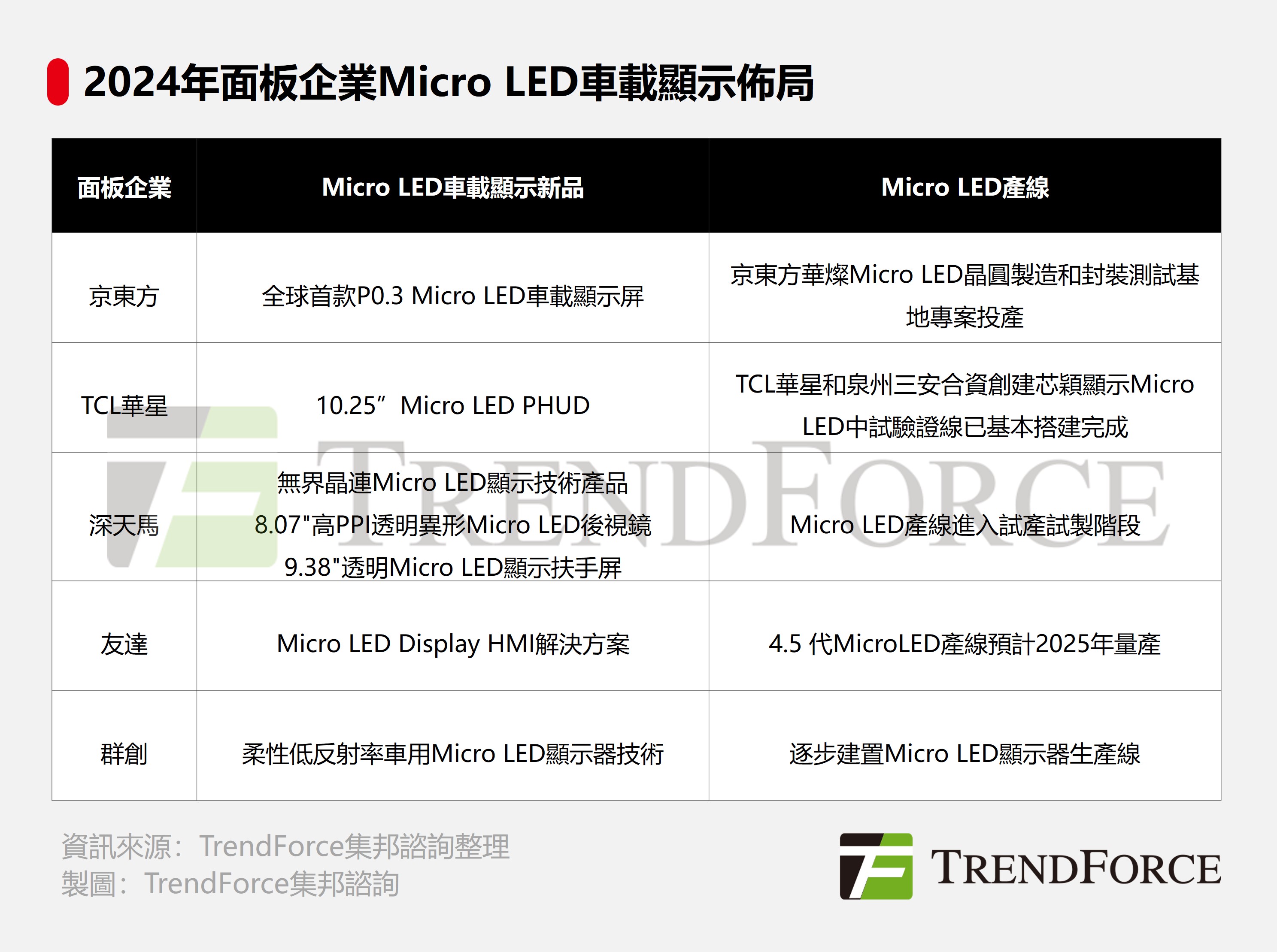
In September of this year, BOE released the world's first P0.3 Micro LED automotive display. This display uses LTPS pixel drivers instead of Micro IC pixel drivers, features curved frameless splicing display, an ambient light contrast ratio of up to 40000:1, a peak brightness of over 2000 nits, and also has a high color gamut and a high refresh rate.
BOE Precision Electronics, BOE's global sales platform for automotive displays, successfully completed trial production of its first-phase prototype at its Vietnam automotive display production base on December 6. Meanwhile, BOE Huacan, a subsidiary of BOE, commenced mass production of its 6-inch Micro LED line in Zhuhai on November 6, demonstrating significant advantages in technologies such as MPD packaging, mass transfer, and color conversion.
TCL CSOT recently released innovative Micro LED automotive displays, including a 10.25-inch Micro LED head-up display (HUD). TCL CSOT revealed that its joint venture with Quanzhou Sanan, Chipwin Display, has made substantial progress in the industrialization of Micro LED technology. In addition, the company is also preparing a Micro LED pilot production line plan.
Shenzhen Tianma is also continuously increasing its investment in the automotive display market. In June of this year, Xiamen Tianma Optoelectronics and Tianma New Display Technology Research Institute jointly held a lighting event for display products such as Micro LED, showcasing automotive instrument displays, high-definition displays, and Micro LED displays, marking the entry of Tianma's 8.6-generation new display panel and Micro LED production line into the trial production stage.
AU Optronics and Innolux, two Taiwanese manufacturers, are also actively promoting the application of Micro LED technology in the field of automotive displays.
In April of this year, AU Optronics completed its acquisition of German automotive component supplier BHTC. The two companies plan to showcase a new smart cockpit integrating Micro LED technology and user-friendly interactive design at CES 2025. AU Optronics' 4.5-generation Micro LED production line is expected to begin mass production in 2025. In addition, Innolux is also building a Micro LED production line.
Summary <br /> By deploying Mini/Micro LED technology, panel manufacturers can enhance their competitiveness in the automotive display field and meet the market's demand for high-performance display technology. At the same time, their deployment also promotes the deep integration and development of Mini/Micro LED with automotive smart cockpits, further driving the intelligentization and high-end development of the automotive industry.
According to TrendForce research, with technological breakthroughs and the increasing demand for automotive displays, the market value of Micro LED chips is expected to grow to $489 million by 2028, indicating a promising market outlook. This growth trend not only reflects the penetration of Micro LED technology in the automotive display market but also foreshadows clearer and more energy-efficient smart cockpit displays in automobiles.


