With the continuous improvement of near-eye display technology, the rise of AI artificial intelligence technology, and the increasing performance of hardware and software, AR/VR/MR smart glasses have once again returned to the forefront of the technology industry. At CES 2025, the grand technology event at the beginning of the year, smart glasses technology became one of the hottest exhibits, with the latest related terminal products, display technology solutions, and optical architecture solutions constantly emerging.
The emergence of new products and technologies will influence the future development of smart glasses, and the smart glasses industry may be entering a new period of rapid development.
AR Glasses: AI Applications Accelerate; Micro OLED Remains the Mainstream Solution <br /> The new AR products showcased at this exhibition demonstrate that, with the rapid development of AI, AR glasses, considered the most suitable carrier for AI, are gradually moving from concept to mainstream awareness. At CES, end-products showed breakthroughs in both technology and specifications. Analysis of end-user demand reveals that the market expansion of AR glasses is closely linked to integrated AI functional platforms. TrendForce believes that the current rise of AI glasses signifies the imminent arrival of the AR glasses wave.
In addition, in terms of near-eye display technology, Micro OLED micro-display technology is still the mainstream choice for AR glasses after balancing display effect and cost. It can reduce the disadvantage in display brightness by combining different optical solutions. The key to the penetration speed of Micro LED technology in AR application field also lies in the industry's control over the mass production rhythm of single-chip full-color technology solutions.
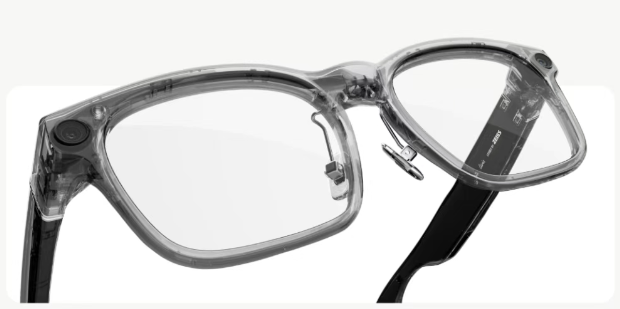
RayNeo X3 Pro

Image source: Thunderbird Innovation
Thunderbird Innovation showcased its latest AI+AR glasses, the X3 Pro. Each pair features Thunderbird's self-developed and self-produced full-color Micro LED fluorescent light engine, boasting 8-bit color depth and a volume of only 0.36cc. The glasses utilize RayNeo waveguide technology, the world's first mass-producible surface-embossed grating-etched waveguide, effectively reducing rainbow effects by 95%. This results in a 0.6mm reduction in thickness, a 25% weight reduction, and high conversion efficiency, achieving a peak brightness of 5000 nits.
Furthermore, the X3 Pro is equipped with a Qualcomm Snapdragon processor featuring a Hexagon™ NPU, delivering high AI performance; its dual-lens camera also significantly expands the applications of AR glasses through AI-driven technology. The X3 Pro is expected to officially launch in Q2 of 2025.
In addition, Thunderbird Innovation also brought its latest AI-powered shooting glasses, the Thunderbird V3, to the exhibition, as well as the Air 3, which was launched last November and features a Micro OLED screen.
Thor AURA AR Lite Edition

Image source: Thunderobot Technology
Raytheon has unveiled three different types of smart glasses.
These include the Thor AURA Smart Glasses AR Lite Edition, a split XR glasses with a Micro OLED + Birdbath optical display solution; the Thor AURA Smart Glasses AR+AI Edition with a binocular full-color array waveguide solution; and the Thor AURA Smart Glasses AI Exploration Edition, which focuses on audio and photography.
The Thor AURA Smart Glasses AR Lite Edition is currently available for pre-order on JD.com for 999 yuan. It features a 46° field of view, supports 0-600 degrees of diopter adjustment, 600 nits of brightness, and weighs only 79g. Official posters indicate that the Thor AURA Smart Glasses AR+AI Edition and the Thor AURA Smart Glasses AI Exploration Edition will be launched in March and May 2025, respectively.
XREAL One series
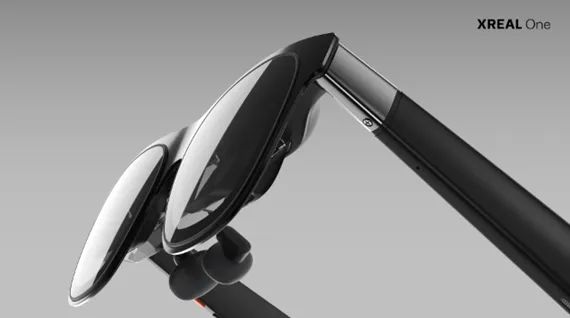
Image source: XREAL
AR glasses brand XREAL showcased its latest AR glasses products, the XREAL One and XREAL One Pro, which are priced at $499 and $599 respectively internationally.
The XREAL One features a 0.68-inch Micro OLED screen from Sony, supporting 1080p resolution and a 120Hz refresh rate, while keeping latency below 3 milliseconds. It is equipped with a self-developed spatial computing chip, X1, which enables the glasses to have built-in three-degree-of-freedom tracking capabilities, allowing them to be used without additional adapters.
As the high-end model in the series, the XREAL One Pro is an upgrade from the XREAL One. Its viewing angle has increased from 50° to 57°, and the screen has been upgraded to Sony's new generation 0.55-inch Micro OLED screen with a brightness of 700 nits. It also features the more advanced Optic Engine 4.0 optical engine.
ThinkAR AiLens

Image source: MeetKai
MeetKai, an AI and immersion technology startup, collaborated with hardware company ThinkAR to launch the ThinkAR AiLens.
The glasses weigh only 37g, have a single green resolution of 640*480, a 30° field of view, and can be used continuously for up to 8 hours on a single charge.
These glasses also feature a front-facing 5MP camera, supporting voice command responses and real-time environmental analysis. Whether for everyday navigation or professional work scenarios, these glasses provide an AI-powered intelligent assistant experience. The product is expected to be available in the first quarter of 2025.
Halliday Glasses

Image source: Halliday Glasses
Halliday Glasses are monocular smart glasses manufactured by Halliday Global. They feature a built-in micro-display, weigh only 35 grams, offer up to 12 hours of battery life, and charge in under an hour. They offer various control methods, including a smart ring, temple control buttons, and voice input.
The display module, supplied by Gyges Labs, supports IPD adjustment to accommodate different interpupillary distances. The lenses can be customized to individual prescriptions, and the resolution is 400 x 400 pixels. Its working principle is similar to Mojo Vision's smart contact lens display module, capable of focusing light directly onto the retina. It is reportedly priced at $489.99.
Rokid showcased its Cupcake series and other AR glasses products.

Image source: Rokid
Rokid showcased its award-winning AR glasses, Rokid Cupcake, which utilizes Sony's Micro OLED display technology. The glasses boast a contrast ratio of 100,000:1, a brightness of 600 nits, and a refresh rate of 120Hz, providing an equivalent viewing experience of a 300-inch screen from a distance of 6 meters.
Rokid also showcased Rokid Glasses, which will be officially available for sale in the second quarter of this year. The glasses can perform multiple functions such as taking photos, translating subtitles, and recognizing objects.
VR Glasses: Micro OLED Microdisplay Technology Further Penetrates, Immersive Experience Upgraded <br /> As VR applications gradually take root and display technology matures, this year's CES saw many terminal companies, including Sony, Pimax, DPVR, and Playful Dreams, showcasing different types of VR devices.
It's worth noting that many new VR glasses products utilize Micro OLED microdisplay technology. According to TrendForce's latest Near-Eye Display report, Micro OLED technology is projected to dominate the high-end VR/MR market, reaching a 23% share in the VR/MR field by 2030.
Sony launches XYN VR/MR glasses

Image source: Sony
Sony showcased its VR/MR device, XYN, which can be used in conjunction with Sony's spatial content creation software to create augmented reality content for Metaverse applications, including 3D objects, animations, and immersive games. Regarding the display, XYN utilizes a 4K Micro OLED microdisplay and full-color see-through functionality. The specific release date for the XYN headset is currently undetermined.
Pimax showcases its ultralight 8K VR headset, Dream Air.

Image source: Pimax Technology
Pimax, a leading VR/MR technology company, has adopted a multi-pronged approach in VR/MR headsets. At CES, Pimax showcased several high-brightness and high-PPD products, including Crystal Super, Crystal Light, and Dream Air.
The Crystal series of headsets, consistently pursuing superior display quality, utilizes aspherical glass lenses with a light transmittance of 99%. The Crystal Super features a 3840 × 3840 pixel display per eye, with users able to choose between a Micro OLED (57 PPD) or QLED (50 PPD) display. It boasts a 120° horizontal field of view. Compared to its predecessor, the Crystal Super is approximately 30% smaller and lighter. Meanwhile, to meet diverse market demands, the lightweight Dream Air headset was introduced, featuring a Micro OLED screen and Pancake optics, weighing less than 200g.
South Korean company P&C Solution showcases MetaLense 2 smart glasses.

Image source: P&C Solution
The METALENSE 2 integrates Qualcomm's Spaces platform, features a Micro OLED display with a resolution of 2560x1440, a replaceable battery, and supports various wireless data communication methods, including LTE. It is currently primarily targeted at the B2B market and is priced at $3,000.
Cornmi showcases its NeoVista X7 VR headset series.

Digital electronics brand Cornmi showcased its NeoVista X7 Pro and Lite series VR glasses, both equipped with Sony Micro OLED full-color screens. The Pro series weighs 79g and features a 90Hz refresh rate, a 62° field of view, and a 2560*1440 resolution.
The Autumn Fruit Project will showcase Wigain MR glasses.

Image source: Autumn Harvest Project
Wigain is a mixed reality (MR) glasses developed by Hangzhou Qiuguo Project Technology. Weighing only 68 grams, it features an 8-core chip, supports AI model inference with up to 1 billion parameters, and is suitable for various fields such as tourism, live streaming, healthcare, office work, and education. In terms of display parameters, the glasses have a resolution of 3840*1080, a 48° field of view, and 500 nits of brightness.
Upstream companies are helping AR/VR glasses develop towards higher definition, intelligence, and lightweight design.
The resurgence in interest in AR/VR devices in recent years is due not only to the hype generated by the entry of tech giants like Apple and Meta, but also to the crucial role played by the continuous optimization and improvement of upstream technologies such as near-eye display and optics. These advancements have enabled smart glasses to be lighter, clearer, more intelligent, and more versatile, with greater usability. At CES, several upstream AR/VR manufacturers showcased various reference designs and related display optical components.
Xitai Technology showcases its 1.35-inch full-color Micro OLED screen for the first time.

Image source: Xitai Technology
Hsitech showcased a variety of full-color Micro OLED display screens, including 0.39-inch 1024x768 resolution, 0.49-inch 1920x1080 resolution, 0.6-inch 1280x1024 resolution, 0.68-inch 1920x1200 resolution, 1.35-inch 355x35-inch production line products, and 12-inch production line products.
Among them, the 1.35-inch product was exhibited for the first time, which can create an immersive visual experience for high-end MR products. In addition, HITTECH, together with its industry chain partners, showcased optical engine module solutions paired with 0.49-inch and 0.68-inch displays.
Sitan Technology showcases Micro LED micro-display products for AR, automotive, and projection applications.
At CES 2025, Micro LED microdisplay technology manufacturer Sitronix showcased its AR, automotive, and projection technologies. Specific exhibits included 0.13, 0.2, and 0.45-inch Micro LED microdisplay modules, as well as a 0.2-inch Micro LED white light display module.

Image source: Sitan Technology
Among them, the 0.2-inch full-color display module is designed for the thin and light needs of the AR/XR field, and has significant improvements in brightness, contrast and response speed.
The 0.2" white light display module has advantages in terms of small size, low power consumption and low cost compared to existing vehicle projection lights. The resolution is further improved to 110*110, the pixel pitch is 40*40μm and the brightness is 150lm.
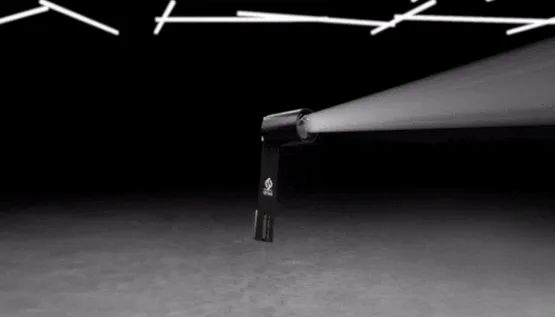
Image source: Sitan Technology
In addition, Sitronix also shared its latest maskless lithography technology for high-power AlGaN deep ultraviolet Micro LED displays at the exhibition. Currently, Sitronix is actively promoting the commercialization and verification of its deep ultraviolet Micro LED maskless lithography technology.
French company Aledia announces construction of a 1.5 billion yuan Micro LED production line . Aledia, a French developer of 3D structure GaN LED technology, showcased D-LED (digital LED), a high-performance Mini LED solution for LCD local dimming backlight units; NOVA high-voltage Micro LED, based on 3D nanowire technology, seamlessly integrated with TFT backplanes; and monochrome and RGB microdisplays with optimized power efficiency and form factor design.
It is worth noting that, according to relevant media reports, Aledia announced at CES 2025 that it would build a Micro LED factory and a $200 million (approximately RMB 1.5 billion) production line for the production of AR displays.
VueReal: Showcasing the Industry's First Micro LED Design Reference Kit
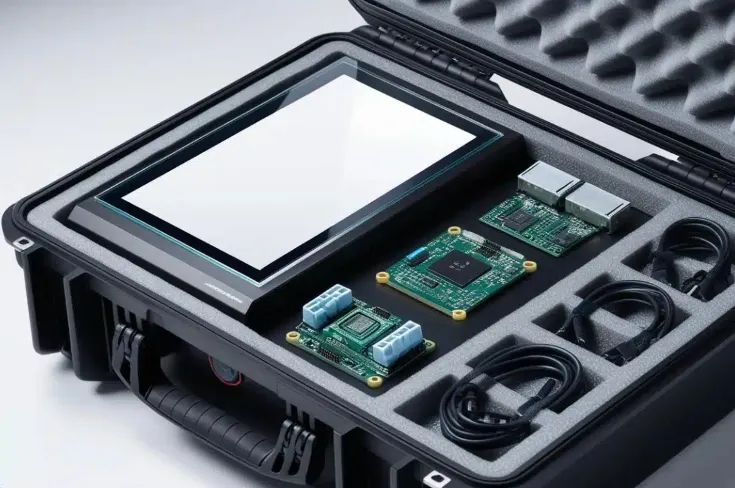
Image source: VueReal
Canadian Micro LED technology developer VueReal has unveiled its Micro LED design reference kits for the first time. These kits are designed to simplify Micro LED product development across multiple sectors, including automotive, augmented reality (AR), consumer electronics, and lighting, helping companies bring Micro LED technology products to market faster and more cost-effectively.
VueReal states that these design reference kits are an important step in simplifying and popularizing Micro LED integration. The kits help companies design and manufacture innovative Micro LED products more efficiently, reducing costs and shortening time to market. At CES 2025, VueReal also showcased its design reference kits and the capabilities of its patented MicroSolid Printing technology.
Appotronics Introduces Ultra-Miniature, Low-Cost Full-Color AR Optical Engine Display Solution <br /> Appotronics brings an ultra-miniature full-color AR optical engine to the AR field. Its volume is only 0.8cc, smaller than a typical Bluetooth headset. It boasts a high contrast ratio of 200:1 and a high resolution of 720P, while also featuring ultra-low power consumption and enabling full-color display.
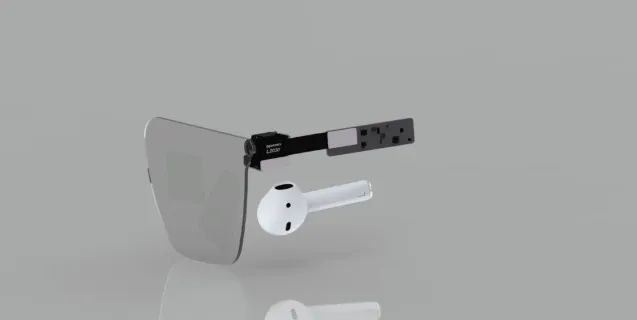
Ultra-compact full-color AR optical engine (Image source: Appotronics)
In addition, Appotronics also showcased home projectors equipped with the latest ALPD 5.0 Pro ultra-full-color laser technology; the world's first laser projection lamp equipped in the smart Genie #5; and the newly upgraded ALL-in-ONE all-purpose laser headlight. In terms of HUD, Appotronics announced a collaboration with Ceres Holographics, and the two parties will actively integrate their efforts in the application of transparent HUDs.
OPTIX, a leading optical brand, has released several new AR/VR optical products.

Image source: OPTIX
Optical technology company OPTIX showcased its latest AR waveguide module and VR ultra-high-definition 8K optical module products. OPTIX also displayed four optical lens products: integrated myopia lenses, fully cemented lenses, zoom lenses, and two-dimensional array waveguides.
Among them, the AR 2D array waveguide module EPIC 50 achieves a 50-degree wide field of view while providing full-color and high-efficiency display effects; the 8K VR Pancake module features a 115-degree ultra-wide field of view and 8K ultra-high-definition display as its core highlights, and also has a built-in 0-800 degree diopter adjustment function; the VR Pancake innovative module integrates fully self-developed eye-tracking technology, which reduces the system's computing load while still meeting the 8K display effect for both eyes.
Vuzix showcases two AR glasses reference designs.

Vuzix introduces the Ultralite Pro OEM platform and the Ultralite Audio OEM platform, both smart glasses reference designs.
The Ultralite Pro OEM platform combines dual full-color Avegant LCoS projectors with ultra-thin binocular waveguide optics to deliver a vivid 3D augmented reality experience. Designed for seamless AI interaction, these glasses integrate voice-activated commands, an onboard camera, and a powerful microphone array for intuitive control and instant photo and video capture.
The Ultralite Audio OEM platform, building upon the Ultralite Z100 glasses model, integrates dual speakers and noise-canceling microphones to enhance audio and voice interaction. It offers AI features such as a voice assistant and real-time language translation. The Ultralite Audio OEM platform also features a monochrome Micro LED projector and up to two hours of battery life.
Vuzix also showcased a full-color 1.0 mm thin optical waveguide solution and various micro-display engines.
Goertek's lightweight AR reference designs Mulan 2 and Wood 2

Image source: Goertek
Goertek introduces lightweight AR reference designs, Mulan 2 and Wood 2, weighing only 36 grams and 58 grams respectively, enhancing wearing comfort. Mulan 2 features an ultra-thin carbon fiber frame and ultra-light titanium alloy hinges, along with holographic waveguide lenses and a Micro LED optical engine to ensure a slim design and minimal light leakage.
Wood2 integrates innovative technologies such as ultra-lightweight material front frame and ultra-small SiP module, supporting full-color displays, high-definition shooting and multimodal AI interaction.
In the VR field, Goertek launched a PC VR reference design featuring a monocular 4K Micro OLED display and a 3P Pancake optical solution. Through optimized design and materials, the overall weight has been reduced to approximately 145 grams, alleviating the burden of prolonged wear. In terms of optics, Goertek introduced a single-optical-engine, binocular diffractive waveguide AR display module employing SRG surface embossed gratings, offering a slim profile and excellent display performance.
ThunderSoft releases lightweight AI glasses and MR reference designs <br /> ThunderSoft's subsidiary, Thundercomm, has launched two innovative reference designs: the lightweight AI glasses Smart Glasses and the mixed reality (MR) HMD Pro.

Image source: ThunderSoft
Smart Glasses are powered by the Qualcomm Snapdragon AR1 Gen1 chip platform and weigh less than 40 grams. They support seamless connectivity with smartphones, feature offline voice recognition algorithms, boast excellent shooting capabilities and electronic image stabilization, allowing users to capture high-quality 2K resolution video and 12-megapixel photos without holding the device.
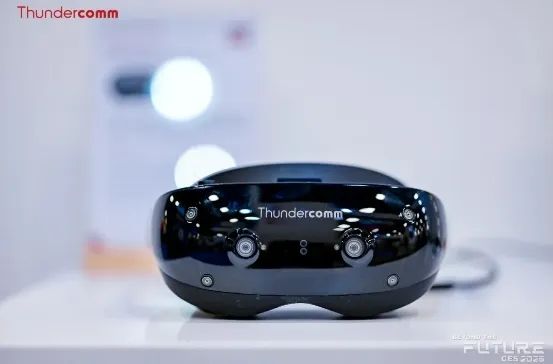
Image source: ThunderSoft
The MR HMD Pro is powered by the Qualcomm Snapdragon XR2+ Gen 2 platform, supporting high-precision, low-latency real-time localization and mapping (SLAM) tracking and hand tracking. Its 6-DOF head tracking capability is combined with dual 32MP RGB cameras. This reference design also features a 4K full-color high-resolution video pass-through camera and display.
Moji Technology showcases two groundbreaking AI+AR glasses designs . Moji Technology presented what it claims to be the world's first AI+AR glasses reference design using resin diffractive waveguides to achieve binocular color contrast. The solution weighs approximately 50 grams and includes a camera and Wi-Fi module, supporting multimodal interactions such as rings, micro-gestures, touch, and voice, enabling an innovative AI+AR smart experience across all scenarios.

Mojit also showcased what it claims to be the world's first semi-rimless AI+AR glasses reference design, weighing approximately 38 grams. Additionally, Mojit also exhibited its resin diffractive waveguide technology and micro-light engine technology solutions.
Summary <br /> Based on this exhibition, intelligence, lightweight design, high image quality, and practicality remain the key areas of focus for AR/VR glasses terminals and upstream companies.
Among them, the rapid development of near-eye display technology in recent years has made a great contribution to the lightweighting and high-definition of smart glasses, becoming an important driving force for the further development of smart glasses.
What's next for near-eye display technology, and what new developments will it bring to smart glasses? On February 26th and 27th, WitsView, a subsidiary of TrendForce, will host the 2025 TrendForce New Display Industry Seminar (DTS 2025) at the JW Marriott Hotel Shenzhen. Display industry leaders and analysts will provide comprehensive analysis and answers at the seminar.