Recently, the "618" mid-year sales promotion has been launched on e-commerce platforms such as JD.com and Taobao, with products such as televisions, mobile phones, and home appliances becoming consumer hotspots. At the same time, offline marketing activities have also attracted attention.
According to the China Securities Journal, a Shenzhen homeowner recently purchased a 163-inch Hisense UX Micro LED borderless giant screen through a Hisense Quality Home exclusive store for 799,900 yuan. This is reportedly the first user case of the 163-inch Hisense UX screen.
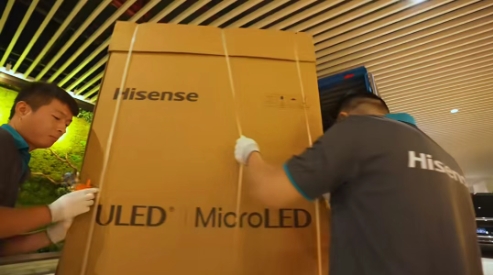
Image source: Screenshot from Hisense TV's video account
Enterprises are actively embracing Micro LED TVs/Large Screens <br /> The 163-inch Hisense UX Micro LED Borderless Giant Screen purchased by the Shenzhen homeowner is a product released by Hisense in March of this year. It integrates 24.88 million Micro LED chips and is also equipped with Hisense's self-developed Micro Black Hole Imaging Technology, Light and Color Simultaneous Control Dual-Core Architecture, 3D Nano Packaging Technology, and other technologies.

Image source: Screenshot from Hisense TV's video account
Hisense also launched its first consumer-grade Micro LED TV, the 136MX, at CES 2025 this year. The product features a high-density array of more than 24.88 million Micro LEDs and a brightness of up to 10,000 nits.
Besides Hisense, other technology and consumer electronics brands such as Samsung, Sony, LG, TCL, Konka, and ASUS, as well as LED companies such as Leyard, Lehman Optoelectronics, MTC Crystal Display, Chuangxian Optoelectronics, and Absen, and panel manufacturers such as BOE, have all launched Micro LED TV/large screen related products.

In terms of price, these Micro LED TVs/large screens are generally priced relatively high.
The Hisense UX Micro LED Borderless Giant Screen mentioned above was sold for as much as 799,900 yuan. In addition, TCL's 163-inch Micro LED Giant Screen TV X11H Max, released last year, was also priced at 799,999 yuan. Samsung's 89-inch and 110-inch Micro LED TVs previously launched in China were priced at as much as 749,999 yuan and 1,049,999 yuan, respectively.
In terms of size, the products range from 65 inches to 236 inches, with several brands offering 163-inch products, such as Hisense, TCL, Lehman Optoelectronics, Absen, and Chuangxian Optoelectronics.
Lehman Optoelectronics entered the home giant screen market in 2021 and successively launched standard size products such as 110, 138 and 163 inches. In 2023, it released a 220-inch home giant screen using PM-driven glass-based Micro LED display.
Leyard also launched its Planar brand Micro LED home TV series as early as 2021, with sizes covering 108 inches, 135 inches, 162 inches and 216 inches.
ASUS's main focus is on computers and laptops, but in April of this year, it unveiled a 162-inch Micro LED Proart home theater screen at NAB 2025. The product features a 0.93 pixel pitch and a peak brightness of 1200 nits.
Micro LED technology is expensive and technically challenging, but its prospects are promising . However, judging from the first user case of Hisense's 163-inch Micro LED TV, the price of Micro LED TVs remains high, making it difficult to popularize them in ordinary households in the short term.
However, advancements in technology and production capacity are gradually changing this situation.
To address the challenge of mass transfer, Leyard's new generation Hi-Micro technology, released in April this year, employs a self-developed laser mass transfer process, which can improve transfer efficiency and system stability.
Unilumin Technology has made breakthroughs in the challenges of mass transfer technology by deploying MiP packaging technology, achieving substrate-free 0202 packaging of Micro LEDs with dimensions of 30 micrometers * 50 micrometers, and simultaneously realizing mass production of MiP P0.4 pitch display products.
Chenxian Optoelectronics has also overcome key technical challenges such as mass transfer, drive architecture, seamless splicing, and binning.
Similarly, packaging manufacturers such as Nationstar Optoelectronics, Hongli Zhihui, and Refond Optoelectronics are also making efforts. Among them, Nationstar Optoelectronics showcased its Micro LED display device solution at ISLE in March this year, which uses its self-developed mass transfer technology to directly transfer Micro LED chips onto the CMOS driver substrate, achieving a minimum pixel pitch of 7.5μm.
In terms of cost reduction, Lehman Optoelectronics launched a PM driver + glass substrate technology solution, which jointly broke through the problem of TGV glass through-hole technology. The released products performed well in terms of energy saving, screen temperature, color reproduction, etc., and had low manufacturing costs.
In terms of panel manufacturers, BOE has acquired a controlling stake in HC SemiTek, an upstream LED chip company, and is involved in the research and development of Micro LED chips, continuously improving chip efficiency. At the same time, it is cooperating with internationally renowned equipment and materials companies to develop mass transfer technology, and has now completed the planning and construction of the 2.5th generation mass transfer pilot line.
It is worth mentioning that universities and other research institutions are also tackling the challenges of mass transfer. For example, recently, a team at Pohang University of Science and Technology (POSTECH) in South Korea developed an innovative dry adhesive technology that has the ability to transfer Micro LED chips with high precision, and is expected to promote the mass production and intelligent manufacturing of Micro LEDs in the future.
Of course, capacity building is also progressing steadily. Currently, manufacturers such as Leyard, Nationstar Optoelectronics, BOE, TCL CSOT, and Tianma are actively promoting it. Among them, BOE has built the BOE HC SemiTek 6-inch Micro LED mass production line and the Zhuhai Jingxin MLED module production line. These two production lines will achieve mass production and start product delivery in March 2025, respectively.
Summary <br /> Although Micro LED technology is currently costly and complex, with the joint efforts of all parties in the industry, it is expected to mature rapidly and enter the consumer market on a large scale in the future. (Text: Mia)