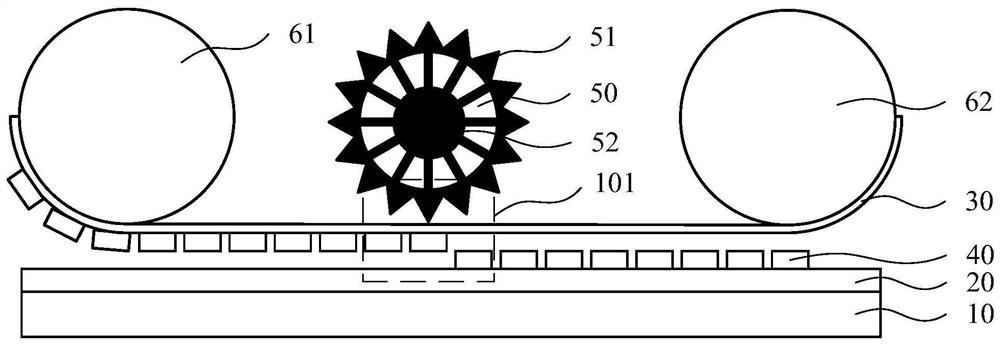
Recently, Professor Chen Enguo's research group at the National-Local Joint Engineering Laboratory for Flat Panel Display Technology, School of Physics and Information Engineering, Fuzhou University, led by Guo Tailiang and Yan Qun, has made progress in AR near-eye display technology research. The team has for the first time realized a retinal projection display (μRPD) architecture based on the integration of image transmission fiber and Micro LED. The related findings, titled "Micro‐LED Retinal Projection for Augmented Reality Near‐Eye Displays," have been published in the journal Laser & Photonics Reviews.

Image source: Laser & Photonics Reviews
Retinal Projection Display (RPD) is a technology that projects virtual images directly onto the retina through the center of the pupil using a projection engine, showing potential in solving the convergence-accommodation conflict (VAC) problem in near-eye AR displays.
However, existing RPD architectures generally employ passively emitting microelectromechanical systems (MEMS) or spatial light modulators (SLMs), which face challenges such as limited beam aperture and lack of structural flexibility.
To address the aforementioned issues, the research team proposed a novel Micro LED retinal projection display architecture that combines actively emitting full-color Micro LEDs with pixel-by-pixel imaging fiber bundles, thus altering the traditional RPD design. Furthermore, the use of flexible fiber bundles provides the system with an adaptable structural design, enabling photoelectric separation capabilities.

Image source: Laser & Photonics Reviews
Based on the aforementioned technologies, the research team developed a full-color miniature retinal projection display (μRPD) prototype, achieving clear imaging over a wide depth of focus. Notably, this μRPD architecture enables underwater AR display without special waterproofing, demonstrating its potential adaptability and versatility in harsh environments. This design opens new avenues for the practical application of near-eye displays in complex and demanding scenarios, driving the development of near-eye display systems. (Compiled)