A cross-disciplinary research team from National Yang-Ming University and Foxconn Research Institute recently announced a groundbreaking optical communication technology, successfully achieving the first "monolithic integration" of a metasurface and a photonic crystal surface-emitting laser (PCSEL). This innovation overcomes the bulky size and complex alignment problems of traditional optical systems, creating an unprecedentedly lightweight and highly efficient functional laser element. Its important applications in 3D sensing structured light lidar and polarization-division multiplexing free-space optical communication (FSO) systems have been successfully demonstrated, and it is expected to bring revolutionary changes to next-generation sensing and optical communication technologies.
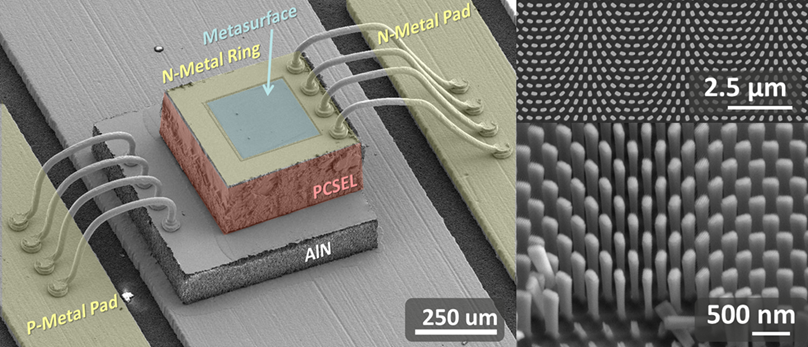
Figure 1. SEM image of the Meta-PCSEL component and its metasurface.
Breaking through traditional frameworks to achieve chip-level miniaturized optical systems <br /> With the exponential growth of data traffic in the Artificial Intelligence (AI) and Internet of Things (IoT) ecosystems, the market demand for optical communication technologies capable of handling massive amounts of data with low latency is becoming increasingly urgent. Traditional radio frequency (RF) technologies are struggling to cope with bandwidth limitations and spectrum congestion, making free-space optical communication (OWC/FSO) a highly promising solution. Meanwhile, with the surge in demand for 3D sensing in consumer electronics such as smartphones, XR devices, and robots, miniaturizing complex optical projection systems and reducing power consumption has become a key challenge for the industry. However, most existing systems rely on discrete component assembly, resulting in large sizes and requiring precise alignment to operate.
Led by Professor Hao-Chung Kuo, Chair Professor at National Chiao Tung University and Director of the Semiconductor Institute at Foxconn Research Institute, and in collaboration with Associate Professor Yao-Wei Huang from National Chiao Tung University and Dr. Yu-Heng Hung's team from the Semiconductor Institute at Foxconn Research Institute, a meta-PCSEL device has been created by directly integrating the meta-interface onto a PCSEL chip. This single-chip integrated design not only significantly reduces the device size but also eliminates the challenges of complex optical assembly and alignment, laying the foundation for the miniaturization of 3D sensing and optical communication systems.
3D sensing and polarization multiplexing demonstrate diverse application potential . The research team successfully developed two key applications by designing ultra-intelligent interfaces with different functions:
- 3D Sensing and Structured Light Projection: The team designed the metasurface as a "meta-hologram," which can precisely project PCSEL laser beams into complex structured light patterns. This component is only 0.025 mm³ in size, a staggering 2450 times smaller than commercial DOE-VCSEL array solutions (such as the iPhone's Face ID system). Furthermore, its power consumption is more than 28.7% lower than commercially available VCSEL array solutions. Although slight distortion of the light spot occurred in the experiment due to manufacturing challenges, the component still successfully performed a single-shot depth sensing task, demonstrating its enormous potential in consumer electronics fields such as face recognition and XR devices. This achievement, "Monolithically Integrated Metasurface on a PCSEL for Depth Perception," was published in the internationally renowned journal Nano Letters and selected as the journal's cover.

Figure 2. Nano Letters journal cover, volume comparison with other modules, and depth sensing results.
- Polarization-Multiplexed Free-Space Optical Communication: The team utilized a meta-interface to achieve excellent polarization control, enabling the simultaneous emission of two beams with opposite circular polarization states. This design achieves dual-channel polarization-multiplexed transmission without the need for additional optical components, effectively improving communication bandwidth. This meta-PCSEL element exhibits superior communication performance, with modulation bandwidth exceeding 2.5 GHz for each polarization channel and data transmission rates reaching 1.3 Gbit/s. Furthermore, compared to traditional PCSELs, this integrated element exhibits more stable spectral characteristics at different temperatures and possesses better thermal stability, which is beneficial for improving stability in harsh environments. The research findings, "Compact Polarization-Multiplexed Optical Transmitters through the Monolithic Integration of Metasurface and Photonic Crystal Surface-Emitting Lasers," have been published in the internationally renowned journal ACS Photonics.
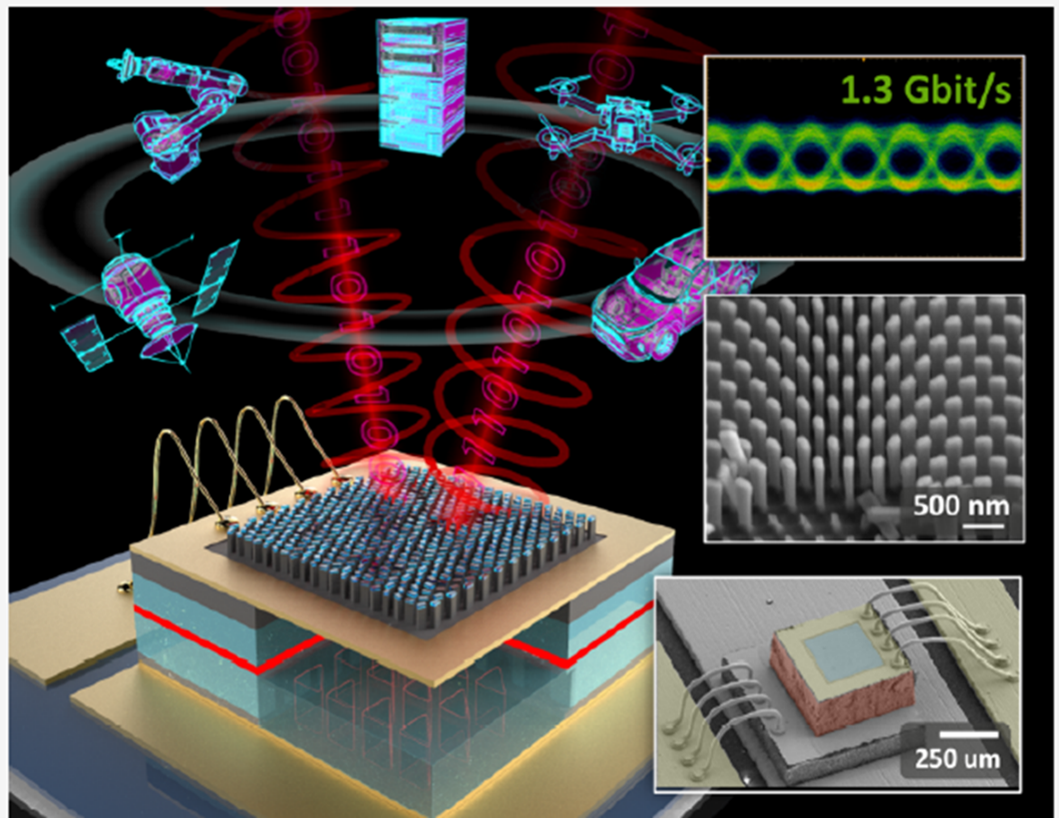
Figure 3. Polarization multiplexing and multichannel free-space light transmission results of the integrated element.
Future Outlook: Achieving Greater Efficiency and Diverse Functionality <br /> This monolithically integrated meta-PCSEL technology not only represents a significant advancement in the miniaturization of optical components, but also paves the way for integrated photonic systems that combine active light sources with advanced wavefront manipulation technology, heralding a lighter, more efficient, and multifunctional future. This technology is expected to be applied in a wide range of fields, including data centers, cloud computing, autonomous vehicles, smart robots, virtual/augmented reality, and quantum computing, injecting strong momentum into Taiwan's competitiveness in the global optoelectronics industry.