The strategic choices of industry leaders often have a significant impact on the overall situation, and their strategies serve as a bellwether for industrial development.
On September 17, Meta, a well-known American technology company, plans to launch its first mass-produced AR glasses, Meta Celeste (codenamed Hypernova), at its annual Connect conference. The glasses will be equipped with a microdisplay featuring LCoS technology, which will be a major highlight in the AR industry.

Image source: AI-generated (not a product image)
However, there is never a standard answer to the technical route. Although LCoS technology has the advantages of maturity and cost, it also faces challenges in miniaturizing the size of the optical engine and power consumption. In contrast, OLEDoS (Micro OLED) and LEDoS (Micro LED) technologies have more room for imagination in terms of display performance. The strategic choices of different manufacturers reflect their respective judgments on the market pace and future direction.
Meta's bet on LCoS indicates a focus on the mass AR market.
Hypernova means "supernova," which shows Meta's high expectations for this product.
Regarding pricing, Hypernova was previously expected to cost over $1,000 (approximately RMB 7,147), but according to Bloomberg, Meta has reduced the price to $800 (approximately RMB 5,717) by optimizing costs. Meta's move is intended to stimulate market demand and accelerate product adoption with a lower profit margin.
In terms of hardware, Hypernova uses a full-color LCoS+ array waveguide architecture with a peak brightness of 2,000 nits. However, due to the backlight, LCoS cannot achieve complete darkness and has relatively high power consumption. Therefore, in order to ensure battery life, Meta only adopted a monocular display solution, and the whole device weighs about 70 grams.
Hypernova also pioneered the sEMG neural wristband, enabling contactless operation via gestures, while retaining touch functionality on the temples. Its multimodal AI capabilities are also extensive, including real-time visual search, voice assistant, and social live streaming. Furthermore, the glasses are equipped with a Snapdragon AR2 Gen 2 chip, allowing for improved real-time translation, scene recognition, and other edge AI functions.
It is worth noting that Hypernova is Meta's first mass-produced AR glasses truly aimed at the general public. Previously, although Meta had launched many products, such as the high-end concept phone Orion and the smart glasses developed in collaboration with Ray-Ban, the former was mainly used to showcase cutting-edge technology, while the latter had relatively basic functions.

Taking Orion as an example, the product uses an LEDoS micro-display panel, with a production cost of nearly $10,000 per unit. In addition, its silicon carbide waveguide sheet also has certain limitations in terms of production process and cost. In contrast, Hypernova is priced at less than $800 and has AI interactive functions, which is more in line with the current mass market demand.

Orion (Image source: Meta)
Meta plans next-generation AR technology
Meta chose LCoS technology for its Hypernova glasses, prioritizing functionality, user experience, and cost over the pursuit of cutting-edge display technology, thereby promoting the widespread adoption of AR glasses products.
It is believed that LCoS technology will emerge in the market in the short term with the adoption of Meta. However, OLEDoS remains the mainstream technology in China due to its cost advantage; the growth of AR glasses with single green LEDoS prompts is also driving the increase in the technology penetration rate of LEDoS.
In the long term, it is pointed out that with the addition of AI functions, AR devices are increasingly demanding higher computing power and battery life, and are setting higher standards for display performance. Overseas manufacturers are more inclined to develop high-specification full-color LEDoS technology, and it is estimated that by 2030, the shipment of AR devices equipped with this technology will reach 20.9 million units, with a penetration rate of 65%.
In response to this trend, Meta has already begun its strategic planning.
On the one hand, Meta aims to optimize the user experience through mid-term product iterations. It is understood that Meta plans to launch the Hypernova 2 in 2027, with the new product upgraded to a dual-lens display using a high-brightness, low-power OLEDoS screen.
On the other hand, Meta is strategically positioning itself with LEDoS technology to prepare for potential future technological breakthroughs. This is reflected not only in Meta's own R&D but also in the accelerated development of related technologies by its supply chain partners.
In August of this year, Goertek, a supply chain company, announced its investment in Plessey, an LEDoS technology provider. It's worth noting that Plessey and Meta have collaborated multiple times; in 2020, Plessey obtained an exclusive license for Meta's AR display technology and procured all of Meta's AR screens. In January of this year, the two companies jointly developed the world's brightest red LEDoS display, suitable for AR glasses.
A flurry of new OLEDoS/LEDoS AR glasses products were released.
Meta's series of moves not only reflect its own technological reserves but also the common trend of the entire AR industry. However, while Meta is making steady progress, some companies have already taken the lead in bringing OLEDoS/LEDoS technology to the market. Since 2024, many companies have released AR products equipped with these technologies, and market competition has gradually intensified.
OLEDoS camp
While OLEDoS has inherent limitations in brightness, it was developed earlier and is more mature than LEDoS technology. According to incomplete statistics, 15 OLEDoS AR glasses were released between 2024 and 2025, from brands including Thunderbird Innovation, XREAL, Meizu, TCL, Skyworth, and ASUS.
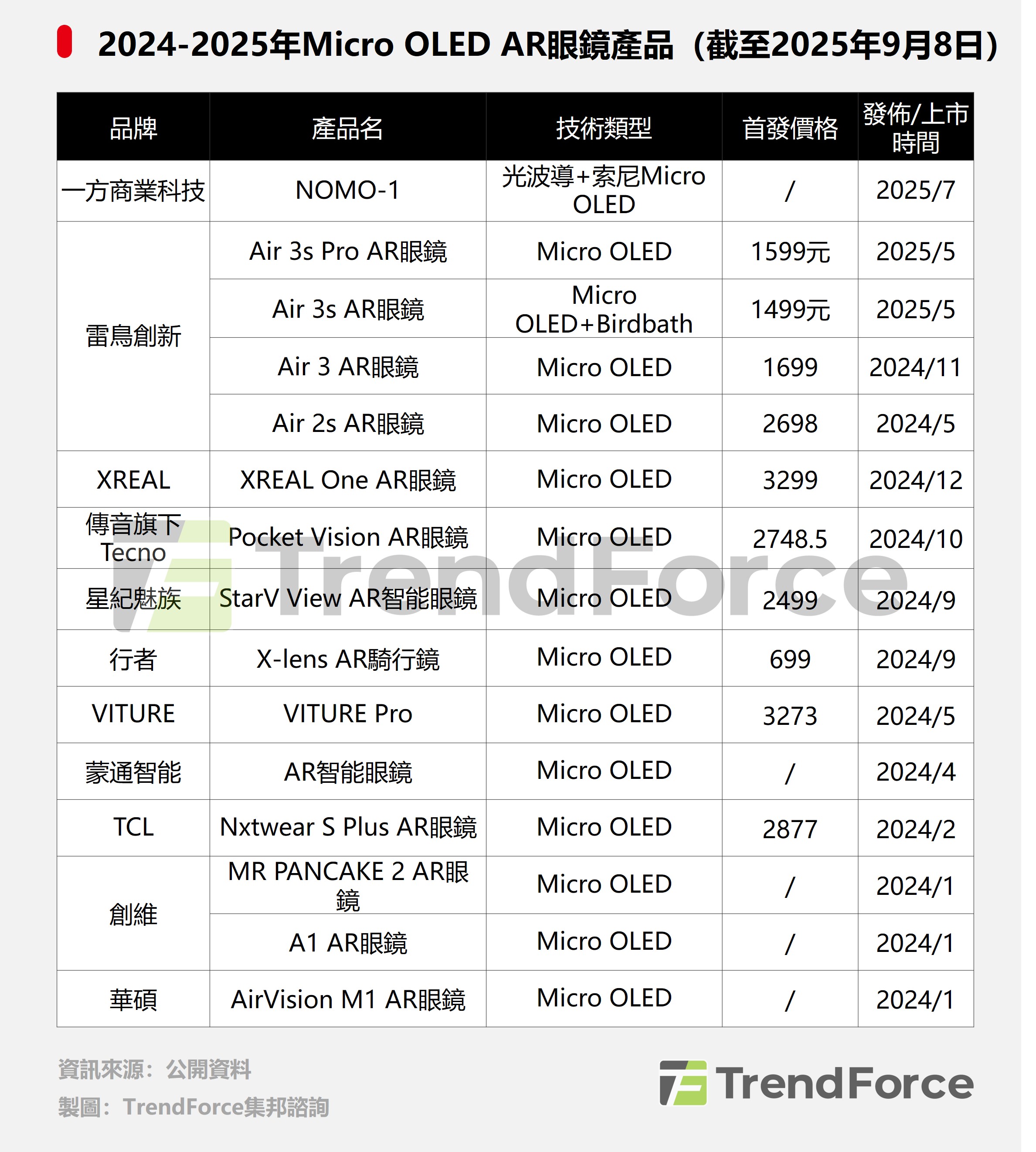
From the new products of some manufacturers, we can observe some changes in the iterative trend. Taking Thunderbird Innovation as an example, it has launched four OLEDoS AR glasses in the past two years, which are positioned to meet entertainment needs. The technology upgrades mainly revolve around user experience, gradually improving display brightness, color and sound quality, as well as adding eye protection technology.

The development of terminal manufacturers such as Thunderbird Innovation is inseparable from the support of upstream supply chain companies.
This year, many domestic companies have promoted the implementation and construction of OLEDoS projects and continued to expand their production capacity, including Visionox Technology, Hongxi Technology, Xitai Technology, Ruixian Technology, and Guozhao Optoelectronics.
Analysts say that in addition to Japanese manufacturers like Sony and Chinese companies such as BOE, Visionox, and HIT, more than ten Chinese manufacturers have begun setting up mass production lines for 12-inch OLEDoS. As progress accelerates, the demand for core materials and components for OLEDoS from these companies will gradually increase.

Taking Eray Technology as an example, in May of this year, it made a large-scale investment in the construction of an OLEDoS microdisplay backplane project, which is expected to add 5,000 silicon-based OLED microdisplay backplanes per month to meet the needs of specific customers and Visionox Technology.
LEDoS camp
The commercialization of LEDoS near-eye display technology is accelerating, gradually moving from monochrome to full-color displays. According to our research, these LEDoS AR glasses products primarily focus on high-definition displays, such as outdoor displays.

Among the aforementioned terminal manufacturers, some positive developments have also emerged recently.
On September 1st, Rokid's consumer-grade AI+AR glasses, Rokid Glasses, went on sale across all channels, with a formal price of 3,299 yuan. According to statistics from relevant media, by 6 pm on the day of the sale, Rokid Glasses had achieved an estimated online sales volume of over 20 million yuan, demonstrating the market's attention and recognition of the product.

Rokid Glasses (Image source: Rokid)
Rokid Glasses is an AI+AR smart glasses product released in November 2024. It is also Rokid's first glasses to feature LEDoS technology and uses JBD's Hummingbird Mini II monochromatic light engine.
It is worth mentioning that JBD is one of the main suppliers of LEDoS microdisplay technology for AR glasses. According to incomplete statistics, JBD's LEDoS microdisplay has been applied to more than 30 AR glasses products, including Microlight Technology's Xuanjing M5, StarV Air2 from Meizu, and G1 from Yiwen Technology.
In terms of ecological applications, LEDoS AR glasses have also made new progress.
In May of this year, Thunderbird Innovations partnered with AutoNavi (Gaode Maps) to launch full-color LEDoS AR glasses integrated with AutoNavi's AI navigation; in August, Thunderbird Innovations also partnered with Ant Group to launch the world's first full-color glasses payment device, the Thunderbird X3 Pro. Furthermore, Meizu announced in April that its LEDoS AR glasses would support offline payment functionality.
In terms of projects, the LEDoS micro-display industry chain has accelerated in mass production, delivery and new project layout since the beginning of this year. Among them, LEDoS projects such as Thunderbird Innovation, Saifures and Novis Technology have been put into production one after another, and BOE Huacan Factory has also achieved product delivery. Meanwhile, Xihu Yanshan completed the signing of an AR/VR chip project, and France's Aledia launched the AR production line project.

While LEDoS still faces some technical challenges, such as optimizing red light materials and implementing full-color display solutions, these challenges are expected to be gradually resolved with technological advancements. In the long run, with the integration of AI capabilities, AR devices will demand increasingly higher performance, and LEDoS is poised to become one of the key technologies of the future.
Although Meta has chosen LCoS, the market is not limited to this path. OLEDoS, LEDoS, and other technologies are developing in parallel with their respective advantages. These diverse technological routes reflect the different judgments of various manufacturers on the market pace and future direction, and together drive the development of the AR industry.


