Navigation is one of the most frequently emphasized applications of AI and AR glasses, but Liu Yi, Vice General Manager of New Market Development at Hongshi Intelligent, put forward a different view at the 2025 Self-Emitting Display Industry Seminar: For riders, navigation may actually interfere with their operation. They need to free their hands and obtain key information with just a "glance".
However, this seemingly simple "glance" poses a severe challenge to AR display technology: it must ensure high brightness under strong outdoor light, maintain a small size for integration into the helmet, and also ensure low power consumption for all-day battery life. Liu Yi believes that only Micro LED can simultaneously meet the requirements of extremely high brightness, extremely low power consumption, and extremely small size.
However, the realization of Micro LED red light technology and full-color capabilities remains a formidable challenge for all players in this field. In recent years, driven by the growing end-user market, related technologies have entered a new phase of development, with innovative technologies constantly emerging and the industry gradually forming diversified technological approaches. At the conference, Hongshi Intelligent shared their solutions to address this core obstacle.
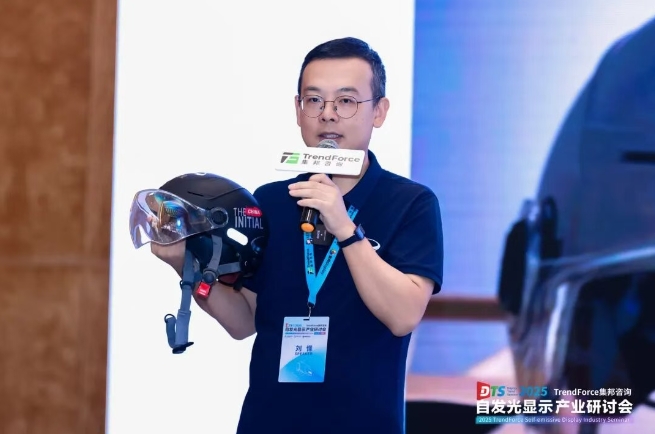
Liu Yihong, Deputy General Manager of New Market Development at Shishi Intelligent
Overcoming the red light gap, a unique technical approach breaks through the brightness bottleneck.
The Micro LED industry faces a well-known challenge – the “red light efficiency gap.” Simply put, gallium nitride materials are reasonably efficient when emitting green and blue light, but when emitting red light with a longer wavelength, the luminous efficiency is severely reduced due to lattice mismatch.
There are multiple technical approaches in the industry, such as AlGaInP, quantum color conversion (QDCC), and InGaN-based red light solutions, each with its own advantages, disadvantages, and technical challenges.
HiteVision has innovatively launched Quantum Dot Color Conversion (QDPR) technology, combining quantum dot materials with photoresist to achieve precise nanoscale patterning on wafers using semiconductor photolithography. This technology enables a peak brightness of 2 million nits for single-red light, surpassing some red light chips using native aluminum gallium indium phosphide (AlGaInP) materials. With this technology, HiteVision becomes the world's first company to break the 2 million nit peak brightness barrier for single-red light.
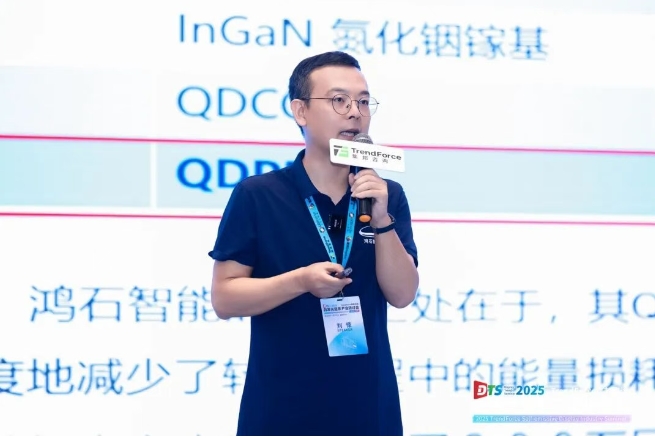
Benefiting from the narrow half-peak width characteristic of quantum dot materials, this optical engine achieves an astonishingly wide color gamut. With a color gamut coverage of up to 109.89% NTSC, 114.37% DCI-P3, and 155.15% sRGB, it ensures seamless integration of virtual image colors with the real world, making the user experience more immersive and realistic.
Meanwhile, the technology also demonstrates excellent reliability. Under 1000 hours of testing, the red light brightness decayed by less than 10%; when tested at operating temperatures above 70°C, the decay was also less than 10%.
A Two-Pronged Approach: A Colorization Strategy of Single-Panel Full-Color and Tri-Color Synthesis <br /> Excellent single-red light performance has laid a solid foundation for Hongshi Intelligent's colorization strategy. The company has adopted a "two-pronged approach," investing equal human resources in both single-pane full-color and tri-color synthesis paths.
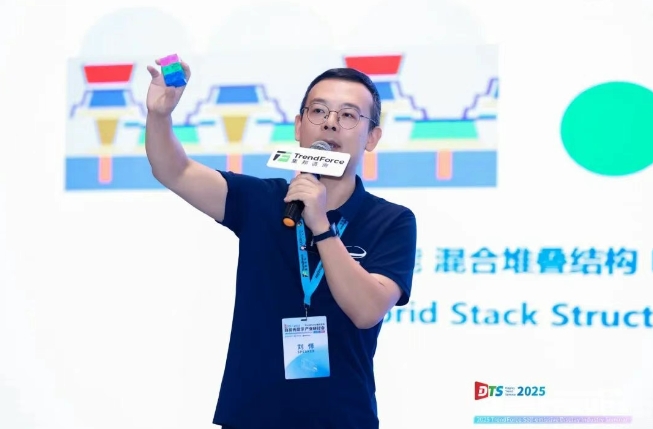
In terms of single-chip full-color technology, Hongshi Intelligent announced in February this year a single-chip full-color micro-display light with a resolution of 320×240, which has achieved a white light brightness of 1.2 million nits. This product uses Hongshi Intelligent's unique hybrid stacking structure (HSS?). The next version will continue to optimize the light effect to achieve the design target of 2 million nits.
This structure integrates two wafer bonding techniques with one quantum dot color conversion technique, cleverly achieving the integration of blue-green epitaxial wafers and the precise rendering of red light. This innovative hybrid stacked structure not only simplifies the manufacturing process of Micro LED chips but also achieves a qualitative leap in photoelectric conversion efficiency.
To illustrate this, Liu Yi explained the challenges of other stacking methods in the industry:
The challenge of vertical stacking (RGB vertically arranged) lies in consistency, and red light (R) must be placed at the bottom layer because if blue (B) and green (G) are below, their light will be absorbed and altered when passing through the upper layers. The challenge of horizontal stacking (blue LED + quantum dot color conversion R/G) lies in the difficulty of achieving high luminous efficacy, and the high complexity of the two color conversion processes.
Hongshi's "hybrid stacked structure" is different: it uses green (G) and blue (B) gallium nitride materials as a base, exposes green pixels through photolithography etching, and then uses quantum dot color conversion technology to precisely convert blue (B) at specific locations into red (R) light. This staggered structure (using a combination of four pixels, two red, one blue, and one green) allows the green pixels to be made larger, thus significantly improving the overall light efficiency. This technology also won the Silver Award at the 3rd China Optoelectronic Exposition in September this year.
In terms of three-color light combining, Hongshi Intelligent has also launched a color optical engine product with a resolution of 640×480 and excellent energy consumption performance, achieving a brightness of 2.5 million nits per 150 milliwatts (mW).
Next-generation platform, from metal bonding to hybrid bonding <br /> Hongshi Intelligent has now achieved mass production of 8-inch silicon-based gallium nitride wafer-to-wafer metal bonding technology, making it one of only two companies in the world to achieve mass production and shipment of a single green Micro LED product. This not only represents Hongshi Intelligent's R&D capabilities in Micro LED, but also its technological level and production capacity.
Regarding the next-generation platform, Liu Yi emphasized that AR glasses customers are constantly pursuing smaller sizes, which means that chip and pixel pitch must be further reduced. To adapt to this trend, Hongshi Intelligent is advancing hybrid bonding.
Currently, HONGShi Intelligent's mass-produced products have a pixel pitch of 3.75 micrometers, using a metal bonding technology. HONGShi Intelligent plans to launch its next-generation product early next year, with a pixel pitch reduced to 2.5 micrometers. As pixels shrink further, traditional metal bonding can no longer meet process requirements, so HONGShi Intelligent has introduced hybrid bonding technology.
The term "hybrid" refers to the alignment bonding of metal elements with silicon dioxide, a structure that significantly improves bonding precision and reliability. Through hybrid bonding, pixel pitch can be reduced to 2.5 micrometers. If a chip size is defined as 0.08 inches, while maintaining a resolution of 640×480, the volume of a monochromatic optical engine can be as small as 0.1 CC, and the volume of a three-color combined optical engine is only 0.18 CC. This will be one of the smallest color Micro LED optical engine solutions currently available in the industry.
AI-AR Helmets and Broader Exploration <br /> Hongshi Intelligent's Micro LED color layout balances both cutting-edge exploration and practical application in its technological iteration. With the completion of the next-generation technology platform, the application areas of Micro LED will be further expanded.
In terms of application expansion, the AI-AR HUD smart helmet mentioned at the beginning of the article is an exploratory product from Hongshi Intelligent, based on the integration of Micro LED micro-display and AI technology. This product was developed in collaboration with leading domestic and international clients, and it integrates mature functions such as projection, camera, Bluetooth, and voice interaction.
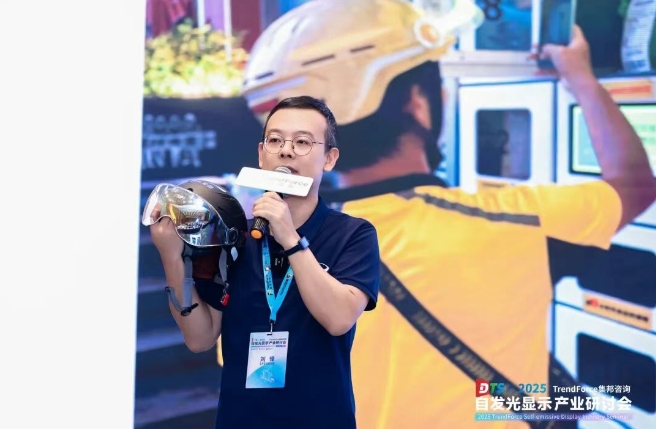
At the meeting, Liu Yi pointed out that although the public generally believes that navigation is the core function of AR helmets, Hongshi Intelligent's extensive research has found that navigation can actually cause serious interference for riders, their target group. Their most real need is to "free their hands" and obtain key information by "glancing".
This application scenario manifests itself in the following way: when a rider operates the delivery locker, they can use voice commands to call the helmet's integrated camera to take a picture and automatically upload it without taking out their phone. The Micro LED projection light engine then displays "Uploaded" on the face mask in real time, and the entire process can be completed without interruption.
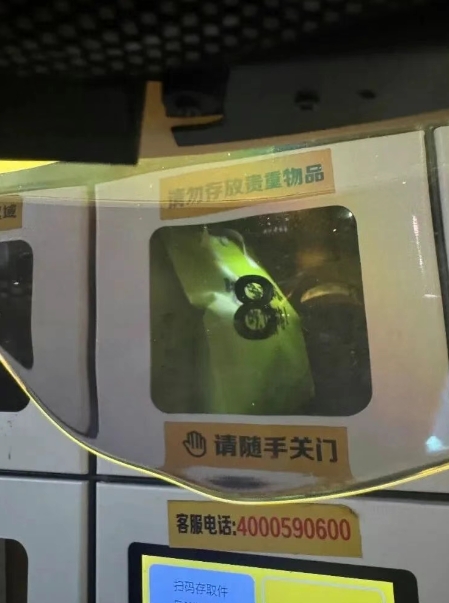
Similar scenarios include: instantly projecting the order number when picking up food, or having the optimal route pushed by the backend when delivery begins. These needs for obtaining key information with a "glance" perfectly match the value of Micro LED micro-display technology, truly integrating AR technology seamlessly into actual workflows.
Summary <br /> From its QDPR technology, which bridges the "red light gap," to its "dual-track" strategy of single-chip full-color and three-color combining, and its future-oriented hybrid bonding platform, Hongshi Intelligent has demonstrated its end-to-end capabilities in the Micro LED micro-display field, from fundamental innovation to mass production. Just as with its profound understanding of smart helmet applications, Hongshi Intelligent is accelerating the industrialization of optoelectronic display technology by bringing Micro LED from the laboratory to the market through solid technological iteration and industrialization practices. (Text: Mia)


