In 2025, the AI glasses market continued to heat up, with an increasing number of participants. From traditional smart glasses manufacturers like Thunderbird and Rokid, to internet companies like Meta, Alibaba Quark, and Baidu, to mobile phone manufacturers like Huawei, and even automakers like Li Auto and Geely crossing over into the field, a competition surrounding AI glasses has begun. Faced with this ever-expanding lineup, this article will focus on the strategic moves of automakers in the smart glasses field, outlining the evolution of this trend for readers' reference.
The Journey of Automakers Exploring Smart Glasses <br /> Over the past decade, automakers' exploration of smart glasses has gradually moved from conceptual attempts to practical applications. With the continuous evolution of smart cockpits in terms of interaction and entertainment, and the development of AI technology, the role of smart glasses is also quietly changing.
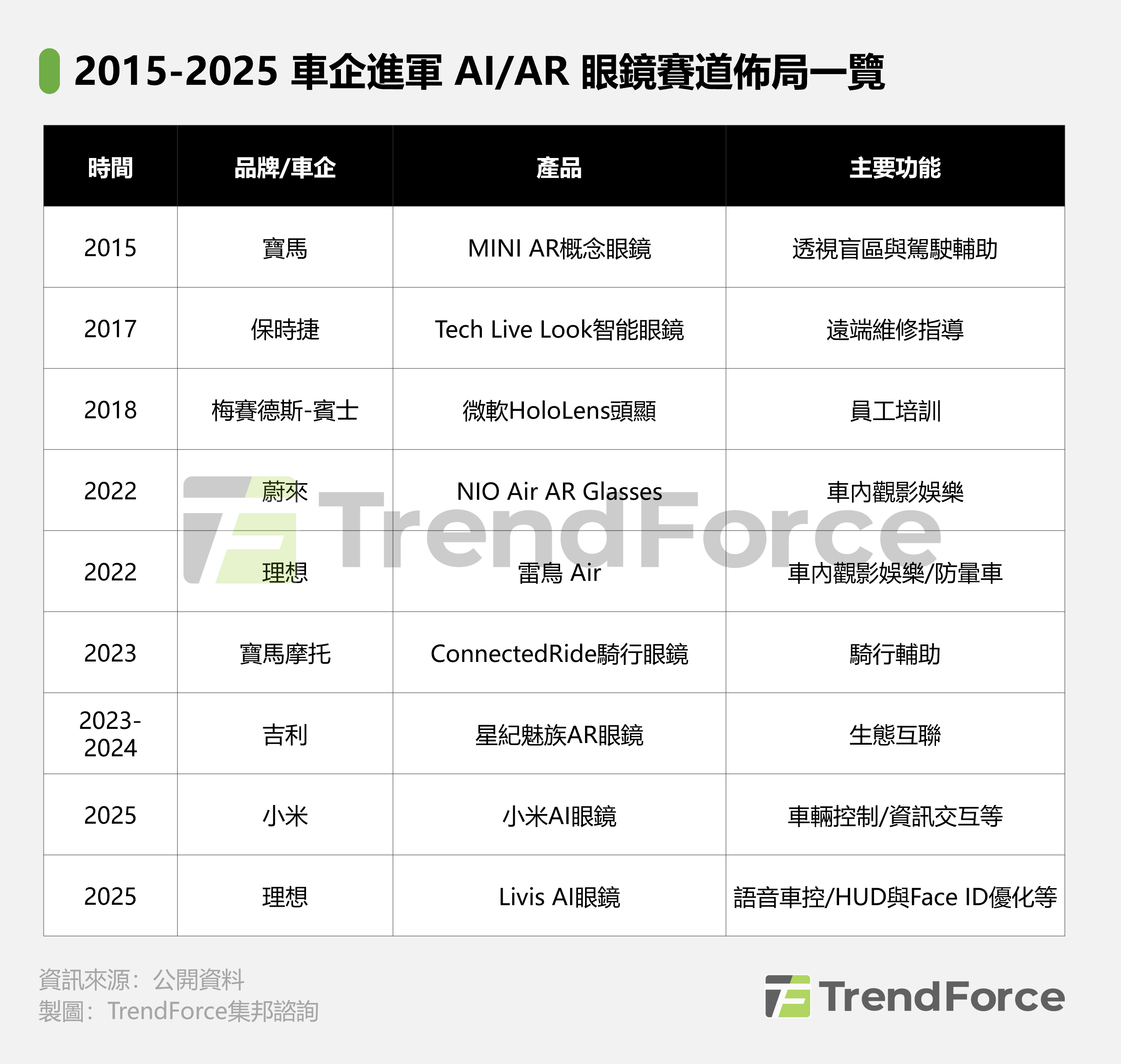
Back in 2015, BMW developed a concept AR glasses called MINI AR Glasses. Besides displaying navigation and speed, this product also had a "see-through" function; when the driver turned to look at the car door, the glasses would use an external camera to eliminate blind spots around the A-pillar and door. However, due to technological limitations at the time, it was never mass-produced.
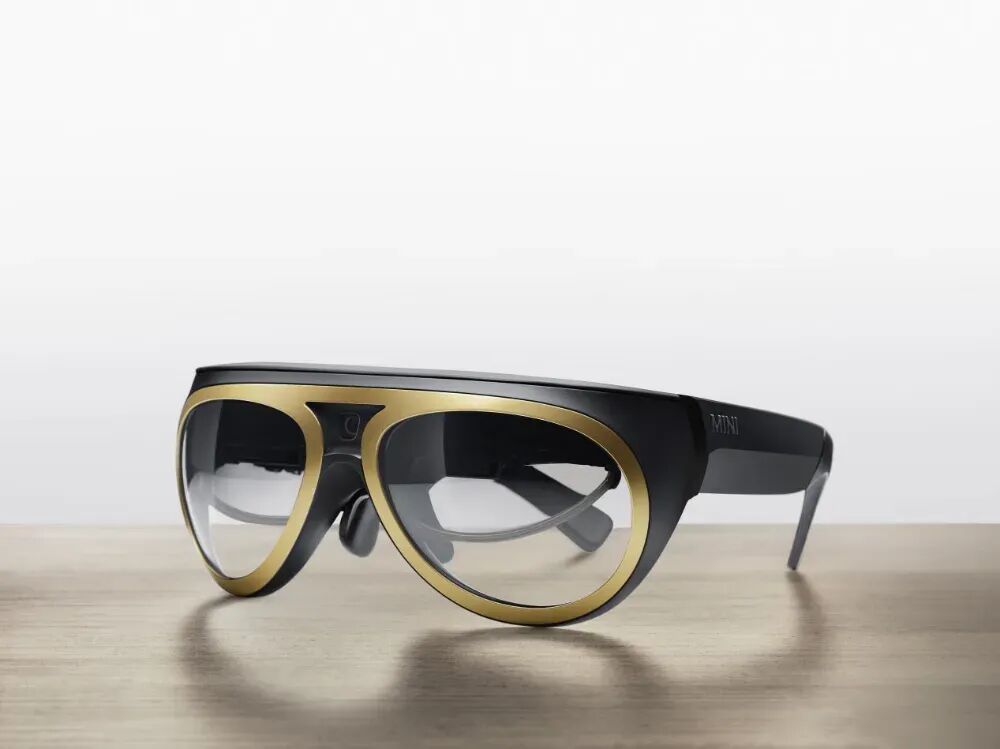
MINI AR glasses (Image source: BMW)
In the following years, smart glasses were increasingly seen by automakers as "B2B productivity tools." Porsche launched the Tech Live Look smart glasses in 2017, which were not intended for car owners but rather distributed to after-sales technicians. In 2018, Mercedes-Benz also began purchasing Microsoft's HoloLens headset for automotive training.
As we entered the 2020s, with the widespread adoption of electric vehicles, car cabins began to transform from traditional driving spaces into "third living spaces," and in-car entertainment functions expanded rapidly accordingly. At this time, the application of AR glasses in the automotive industry underwent a change.
At the end of 2021, when NIO launched the ET5, it officially introduced the PanoCinema (panoramic digital cockpit) concept and announced a partnership with AR unicorn company Nreal (now renamed Xreal) to include AR glasses in the pre-installed optional system.
In 2022, NIO officially launched the NIO Air AR Glasses, co-developed with Nreal. The core of this product is no longer driver assistance, but "in-car entertainment." Through the AR glasses, NIO projects a 130-inch screen equivalent to 4 meters away into the small space inside the car, which, together with the in-car Dolby Atmos sound, can be used to watch movies, sports events, and more.

NIO Air AR Glasses (Image source: NIO official website)
Li Auto followed suit, announcing the introduction of Thunderbird's innovative AR glasses, Thunderbird Air, on models such as the L9. Thunderbird Air is positioned as a consumer-grade entertainment large-screen smart glasses, which, when paired with the vehicle's own 4D immersive audio-visual system, can present a 140-inch high-definition giant screen viewing experience.
In the same year, Geely acquired Meizu and established StarV Meizu. In 2023 and 2024, StarV Meizu released three AR glasses: MYVU, MYVU Discovery, and StarV Air 2, which can achieve vehicle-to-everything (V2X) connectivity through the Flyme system.
It's worth noting that amidst the entertainment trend, some manufacturers are still exploring the application of smart glasses in the field of driver assistance. In 2023, BMW Motorrad launched ConnectedRide Smartglasses, a mass-produced pair of glasses that projects navigation, gear, and speed information into the rider's right eye, addressing a key pain point in two-wheeled driving. These glasses are priced at €690.

BMW motorcycle riding glasses (Image source: BMW)
In 2024, BMW showcased XREAL Air 2 augmented reality glasses at CES, which enhance the driving experience and can display navigation instructions, hazard warnings, entertainment content, and charging station information.
Entering 2025, with the support of AI technology, the AI glasses market has accelerated its development.
In June of this year, Xiaomi launched its first AI smart glasses, which supports integration with automotive devices; in August, Geely announced at its AI cockpit technology launch event that its full-domain AI technology had been officially implemented in the field of smart cockpits; in December, Li Auto officially released its first AI glasses, Livis. It is reported that the Li Auto team officially launched the AI glasses project in 2024.

Livis AI Glasses (Image source: Li Auto official website)
Automakers' Exploration of Entertainment in AR Glasses <br /> Looking back at automakers' exploration in the field of smart glasses, the choice of technological route has always been closely linked to the application scenarios. If we turn back the clock to the 2020s, the concept of a "mobile cinema" in the car became popular, and in-car entertainment became one of the core selling points of competition in smart cockpits. Influenced by this trend, automakers' technological routes for AR glasses also prioritized the viewing experience.
From a display technology perspective, OLEDoS boasts advantages such as high resolution, high refresh rate, and fast response time. Furthermore, it doesn't rely on complex encapsulation processes, making its technology relatively stable and mature, and its costs relatively controllable. While it has an inherent limitation in brightness, this has a limited impact in scenarios where in-vehicle lighting is controllable and viewing needs are paramount. Therefore, OLEDoS is currently a popular micro-display technology in the downstream market.
For example, NIO's NIO Air AR Glasses are equipped with a Sony OLEDoS display, enabling 130-inch aerial projection and a 201-inch AR Sky Screen. Li Auto's Thunderbird Air, introduced in models such as the L9, is also equipped with a Sony OLEDoS display, providing users with a 140-inch high-definition virtual screen equivalent to a distance of 4 meters.

The viewing experience of NIO Air AR Glasses (Image source: NIO)
Similarly, BMW's XREAL Air 2 solution showcased at CES 2024 also featured a Sony OLEDoS display. Since the demonstration included entertainment content and a detailed charging station map, the high resolution and wide color gamut of the OLEDoS enabled clear, full-color presentation of such multimedia information, meeting the visual experience requirements of the demonstration.
However, with the upgrading of smart cockpit display configurations, the single function of watching movies is gradually reaching its limit. Taking the Wenjie M9 released in 2023 as an example, its 10 displays can already cover the entertainment and interaction needs of multiple seats. With the trend of increasing physical screens in the car, the scarcity and necessity of smart glasses as an additional screen are beginning to diminish.
The Development of AI-Powered Smart Glasses for Cars <br /> In the second half of 2024, driven by the market performance of Meta Ray-Ban's AI glasses and the trend of integrating large-scale AI models into vehicles, AI technology accelerated its penetration into smart glasses. By 2025, with advancements in AI interaction technology and chip computing power, smart glasses will no longer be merely display accessories attached to in-vehicle systems, but will evolve into "AI assistants" with independent computing and perception capabilities.
Looking at the AI glasses released this year, the product forms have diverged. On one hand, there are displayless AI glasses that are committed to simplification and pursuing extreme lightweight design; on the other hand, there are AR glasses with displays that continue to delve into visual interaction and explore complex scenarios.
Among them, the displayless AI glasses camp has chosen to forgo expensive and complex optical display modules, focusing instead on voice interaction, image capture, and cloud-based large-scale model services. For example, Xiaomi's first AI smart glasses, launched in June this year, does not feature a complex optical display system but instead focuses on voice interaction and interconnectivity between people, vehicles, and homes, with a starting price of 1999 yuan.
Similarly, the Li Auto Livis AI glasses are designed like sunglasses and do not have an optical display module. Instead, they use optimized lenses to help drivers clearly read HUD information. They are deeply integrated with the "Li Auto Assistant" big data model and support Face ID authentication. Users can control vehicle functions such as air conditioning, steering wheel heating, and tailgate via voice commands. The starting price is 1999 yuan.
From a business perspective, by omitting the display module, the overall hardware structure of AI glasses is simplified, reducing costs. Taking Xiaomi and Li Auto as examples, both have kept their product prices below 2000 yuan. This pricing strategy objectively lowers the barrier to entry for consumers, facilitating product penetration into the mass market and promoting early market adoption.
AI glasses are just a transition; AR glasses are the future . From a market perspective, AI glasses seem to be gradually overshadowing AR glasses. However, industry observers believe that this product form, which emphasizes hearing over vision, is more like a necessary transitional phase in the path to widespread adoption of smart glasses. AR glasses with display capabilities represent the ultimate goal of the industry.
So why are major manufacturers prioritizing AI glasses at this juncture? Chiu Yu-bin, Senior Vice President of Research at TrendForce, offers an interpretation from an industry chain perspective. He points out that, in order to showcase their AI capabilities as early as possible, major international manufacturers are seeking a balance between time pressure and product launch, resulting in them often prioritizing the release of their AI glasses before releasing AR glasses.
However, this does not mean that the AR industry has stagnated. According to the latest report, "2025 Near-Eye Display Market Trends and Technology Analysis," with international brands launching AR glasses prototypes and Meta's expected release of its Celeste AR glasses soon, market attention to AR devices is heating up in 2025. Coupled with the decline in OLEDoS product prices, global AR shipments are expected to reach 700,000 to 800,000 units in 2025.
For the automotive industry, simple voice interaction is insufficient to meet drivers' intuitive needs for spatial perception and navigation, making "visible" AR technology crucial. This has also driven the iteration of micro-display technology solutions. Although OLEDoS is currently the mainstream, LEDoS, with its higher brightness and contrast advantages, is emerging in high-brightness automotive environments.
Having recognized this technological trend, some automakers have already begun to make strategic moves.
Back in May of last year, Geely invested in JBD, an LEDoS microdisplay manufacturer. JBD reportedly has ten years of experience in the LEDoS microdisplay field and is one of the earliest companies in the industry to achieve large-scale mass production of this technology. Currently, JBD's LEDoS products are used in nearly 50 smart glasses models worldwide. Furthermore, it's worth mentioning that Geely's subsidiary, Meizu, has released three AR glasses models—MYVU, MYVU Discovery, and StarV Air 2—all of which utilize LEDoS display technology.
In November of this year, GAC Group and Rokid jointly conducted an application test of "AI smart glasses + car". This collaboration is based on Rokid's latest generation of smart glasses and aims to apply AR and AI technologies to core driving and interaction scenarios in automobiles.
Rokid has reportedly released several enterprise-grade and consumer-grade AR glasses. Among them, Rokid Glasses is Rokid's first glasses equipped with LEDoS technology, and it will be available for sale across all channels on September 1, 2025, priced at 3299 yuan. This product uses the JBD Hummingbird Mini II monochromatic light engine, achieving 8 lumens of brightness at eye level with a typical low power consumption of only 60mW. This high-brightness, low-power technology addresses the pain points of traditional solutions, such as unclear display and insufficient battery life in bright in-car environments, providing drivers with clear visual interaction all day long.
With the maturation of LEDoS full-color technology and the increasing demands of AR glasses on computing power, battery life, and display performance, shipments of AR glasses equipped with LEDoS are projected to reach 20.9 million units by 2030, with a technology penetration rate of 65.0%. Looking ahead, smart glasses are expected to enhance the user experience in more in-vehicle scenarios, especially by providing more intuitive visual interaction in driver assistance.


