Micro OLED technology is gradually becoming one of the preferred technologies for head-mounted display devices such as AR/VR devices due to its advantages in display performance. Recently, another VR device based on Micro OLED technology was officially released.
Pimax Launches Micro OLED VR Headset
On December 24, Pimax launched the Dream Air VR headset, which is now available for pre-order on its official website. The pre-order price is 9,699 yuan, and the final total price is 14,645 yuan. It is expected to start shipping in May 2025.

Image source: Xiaopai
The headset weighs less than 200 grams, supports eye tracking, HDR, and an automatically adjusting headband. It uses a 90Hz Micro OLED panel with a resolution of 3840x3352 per eye, supports HDR, has a field of view of 102 degrees, and features automatic interpupillary distance adjustment.
The device is currently primarily used for PC VR, but in the future, it may be equipped with a built-in Snapdragon XR 2 computing unit, enabling it to function as a standalone VR headset.
2024 Sees Frequent Debuts of Micro OLED Products It's worth noting that Pimax Technology is not alone, with several new Micro OLED products being released recently. On December 5th, AR glasses brand XREAL released the world's first consumer-grade AR glasses supporting native 3DoF (three degrees of freedom)—the XREAL One. The XREAL One uses a Sony 0.68-inch Micro OLED screen, supporting 1080p resolution and a 120Hz refresh rate, while keeping latency below 3 milliseconds.
On November 8th, Aoxue released its high-end flagship MR headset—the Aoxue Vision Max. The device features two Micro OLED displays with a pixel density of approximately 3882 PPI, enabling 4K display for each eye. Furthermore, the device is equipped with Aoxue's self-developed Pancake optical module.
On October 28, Thunderbird released the Air 3 AR glasses, which are equipped with the new Peacock Optical Engine jointly developed by Thunderbird and TCL. It adopts the fifth-generation Micro OLED and a new optical path system, which can achieve 145% sRGB color gamut coverage, 650 nits of brightness and 200,000:1 contrast ratio.
Earlier this year, brands such as Thunderbird Innovation, Transsion, Walkman, Meizu, VITURE, TCL, Skyworth, and ASUS also launched new products using Micro OLED technology.

The new Micro OLED products released in 2024 mainly cover AR, VR and MR applications, with AR applications being the primary focus.
Focusing on AR glasses applications, the optical architecture of AR technology is indeed more complex than that of traditional display devices. This is mainly because AR glasses need to seamlessly integrate virtual images with the real environment, achieve a clear image on relatively small lenses, and ensure wearing comfort.
To meet the specific display technology requirements of AR glasses, products on the market mainly employ two optical solutions: the birdbath and the waveguide. Each solution has its advantages; the birdbath solution excels in brightness and contrast, while the waveguide solution offers greater design flexibility and compactness.
In practical applications, both Meizu's StarV View and Thunderbird Innovation's AR glasses adopt the Micro OLED + BirdBath solution. Specifically, Meizu's StarV View uses a Sony Micro OLED screen + BirdBath optical solution, while Thunderbird Innovation's Air 2s features a self-developed BirdBath light engine and a Sony Micro OLED screen.
According to TrendForce's analysis, based on the existing cost structure, market, and technology maturity, Micro OLED is currently the only technology that can bridge the gap between VR/MR and AR devices. Micro OLED paired with BirdBath is also the optimal solution for balancing cost and display performance. It is estimated that Micro OLED will account for 54% of the AR device market by 2024. While Micro OLED is rapidly improving in resolution, its ability to balance brightness and color display in AR applications remains limited. Its market share will gradually shrink with the development of LEDoS technology, and is projected to decline to 25% by 2030.
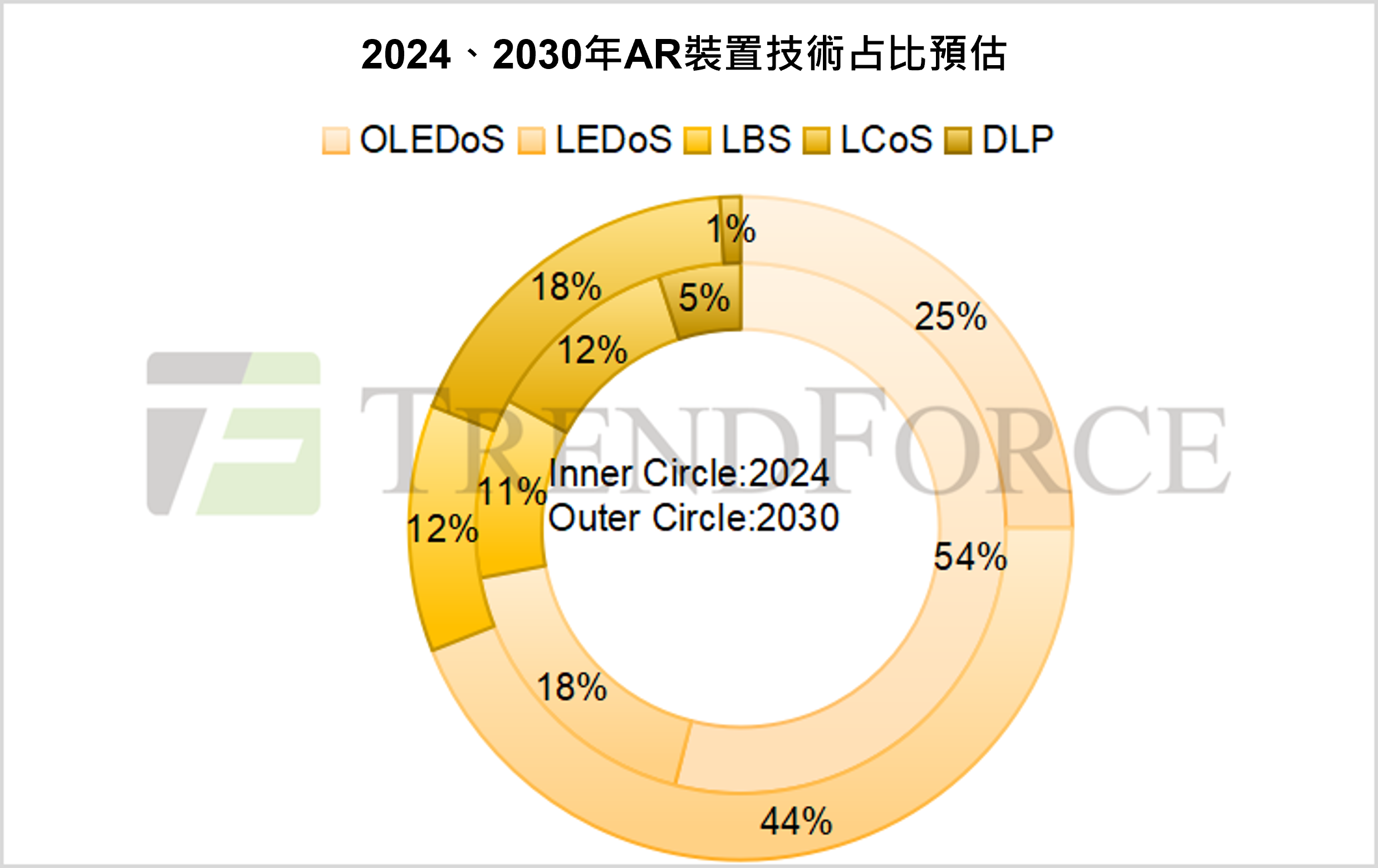
Image source: TrendForce
Furthermore, reports indicate that Samsung plans to relaunch an XR headset in 2025, potentially using a Micro OLED screen, highlighting the promising future of Micro OLED in the XR field.
Summary <br /> TrendForce predicts that Micro OLED will gain a significant competitive advantage in high-end VR/MR applications as supply increases and costs decrease. Despite its promising technological outlook, Micro OLED currently faces some technical and cost challenges, requiring further optimization by the display industry to achieve widespread adoption.
From February 26 to 27, 2025, TrendForce's WitsView and other subsidiaries will host the two-day TrendForce New Display Industry Seminar 2025 (DTS 2025) at the JW Marriott Hotel Shenzhen.
At the event, senior display industry analysts and experts will jointly discuss market trends and technological advancements related to Micro OLED, and conduct in-depth analysis of the industry's future development direction and potential opportunities.


