The advantages of Micro LED technology have attracted the attention of not only LED companies but also panel manufacturers, including Tianma Microelectronics. As a well-known panel manufacturer, Tianma has been actively engaged in Micro LED technology research and capacity building in recent years, gaining a clearer understanding of the technology's advantages and development challenges. Tianma also has a clearer plan for its future development.
At the 2024 TrendForce Self-Emitting Display Industry Seminar, Liu Yongfeng, Product Planning Director of Tianma Micro LED Research Institute, analyzed the latest developments in Micro LED technology and Tianma's latest moves in this field.
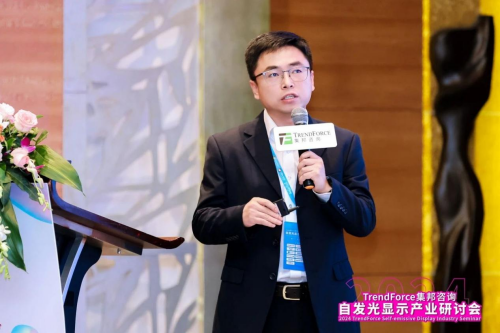
Liu Yongfeng, Product Planning Director of Tianma Micro LED Research Institute
Tianma focuses on Micro LED applications such as automotive displays, PID controllers, and transparent displays . With continuous breakthroughs in LED chip miniaturization technology, the performance of Micro LED display products is constantly improving, and their application areas are expanding. To seize the opportunities presented by the development of Micro LED technology and to promote the implementation of the company's "2+1+N" strategy, Tianma Group has established a first-level department, the Micro LED Research Institute, to conduct Micro LED-related work.
Leveraging its strengths in the panel industry, Tianma is developing related Micro LED applications through glass-based LTPS technology. Tianma's development strategy for Micro LED technology primarily focuses on PID (Public Information Display), automotive displays, transparent displays, wearables, and AR. Among these, PID, automotive displays, and transparent displays are Tianma's key areas of focus.
Automotive displays: Automotive displays are one of Tianma's core businesses, so we attach great importance to the application of Micro LED technology in automotive displays.
Modern automobiles are increasingly incorporating displays, which will become an integral part of future vehicles. Automakers and users have different needs for different automotive display products. For example, head-up displays require high brightness and high PPI; integrated screens, while meeting display requirements, also need curved surfaces to satisfy automakers' design needs; electronic rearview mirrors require high responsiveness; and side window displays require high transparency and high brightness to ensure driving safety.
For these high-end automotive display applications, the performance requirements are high but the cost sensitivity is low, which has become a breakthrough for Micro LED technology.
However, the current LTPS backplane pixel structure and LED chip size are key bottlenecks limiting transparency. As the PPI of automotive displays increases, the transparency will decrease significantly, hindering the application of Micro LED in automobiles. In response, Tianma, leveraging its accumulated design and manufacturing experience in display backplanes, has divided the backplane design into transparent and non-transparent areas. Through special design of the non-transparent areas, the transparent area is increased, enabling automotive display products to achieve a transparency of over 75%.

In addition, Tianma has also developed relevant sample products to meet the demand for high brightness in automotive displays, with brightness reaching over 10,000 nits.
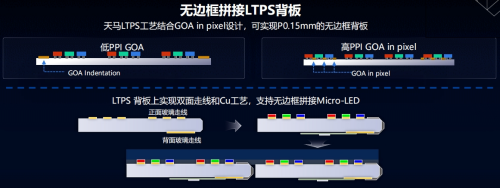
PID Display: In the field of PID displays, the main requirement is to achieve a borderless display design, but realizing a borderless splicing LTPS backplane is a major challenge. Unlike the through-hole routing method of PCB substrates, glass-based Micro LED displays require side routing combined with IC back-bonding processes to achieve borderless splicing.
As the pixel pitch decreases, the space for side traces shrinks in order to maintain a borderless design, and the trace pitch also decreases, which poses a significant challenge to related processes (cutting, edge grinding, side traces, etc.).
To address these issues, Tianma utilizes LTPS technology combined with GOA in pixel design to achieve a frameless backplane with a resolution of 0.15mm. Furthermore, the LTPS backplane enables double-sided wiring and Cu processes, supporting frameless Micro LED splicing.
Transparent Displays: This year, several companies have begun showcasing Micro LED transparent screen products. Compared to OLED and LCD technologies, Micro LED's advantages of high brightness, high reliability, long lifespan, high transparency, and narrow bezels make it more suitable for transparent display applications. Transparent displays have a wide range of potential applications, including landmark buildings, cultural and museum exhibitions, rail transit, retail displays, and hotels, and future demand is promising. Therefore, Tianma believes that transparent screens will be one of the breakthroughs in the future development of Micro LED technology.
Tianma continues to enrich its Micro LED product lineup; the entire production line is about to be completed . Currently, targeting development directions such as automotive displays, PID displays, transparent screens, and wearables, Tianma has released several Micro LED display products in recent years, including a 7.56-inch transparent screen, a 5.04-inch splicing screen, a 9.38-inch transparent screen, an 8.75-inch transparent screen, and a 9.38-inch adjustable transparent screen.

This year, Tianma also showcased a wealth of the latest achievements in Micro LED technology. For example, in October, Tianma, in collaboration with Xiamen University and the Xiamen Future Display Technology Research Institute, announced the development of a 1.63-inch ultra-retina TFT-based Micro LED full-color display with a PPI of 403.
At the 2024 Tianma Innovation Conference in November, Tianma and Hisense jointly launched the Boundless Crystal Connect Micro LED display technology product, with a pixel pitch of only P0.4 and features such as frameless design, no screen flicker, and free splicing.

Boundless Crystal Connectivity Micro LED Display Products (Image source: Tianma)
At the conference, Tianma also collaborated with companies and organizations such as the Wujin Nanjing University Future Technology Innovation Research Institute, Corning, and the China Electric Vehicle 100 Forum to jointly promote the advancement of Micro LED technology applications. In addition, Xi Keri, Vice President of Tianma Microelectronics' Micro LED Research Institute, revealed at the conference that Tianma's Micro LED production line will finalize its process by the end of this year, achieving full process integration; next year, it will focus on improving production yield and efficiency, moving towards small-batch production.
Looking ahead to the future development trend of Micro LED, from a technological perspective, Tianma believes that Micro LED will shift from low PPI to high PPI, and the requirements for equipment and processes will also increase from easy to difficult. From a market perspective, Micro LED technology will first be introduced into areas with low price sensitivity, and then develop towards more sensitive areas such as the consumer market.
Based on the above logic, Micro LED applications will initially focus on large-size splicing displays, then expand to watches, automotive displays, and in the more distant future, tablets, monitors, and mobile phones. Therefore, cost reduction will remain key to the future development of Micro LED.
At TrendForce's self-emissive display industry seminar, Liu Yongfeng stated that the challenges facing the industrialization of Micro LED mainly stem from three aspects: backplane, manufacturing process, and chip. Tianma is confident in collaborating with more industry partners to develop Micro LED technology, continuously overcome the difficulties in yield and cost, and promote the industrialization of Micro LED. (Text: Irving)


