IRIS Optronics, a global leader in ChLCD technology, officially showcased its latest technological achievements at the Touch Taiwan exhibition from April 16th to 18th. These included the world's first ultra-wide color gamut electronic paper display, advanced ChLCD and optoelectronic technology integration solutions, and modular displays capable of large-size splicing. The launch of these innovative technologies not only enhances display performance but also meets the future demands for green environmental protection and high efficiency, symbolizing a new peak in the development of color electronic paper applications. IRIS Optronics' demonstration also signifies the widespread application of "true full-color, ultra-wide temperature, zero carbon emission" display technology in diverse fields, providing a new solution for the future of smart displays. Breakthrough ChLCD technology leads a new era in full-color electronic paper applications. IRIS Optronics' innovative achievements are deeply rooted in its R&D strength in ChLCD technology. Dr. Liao Chi-chang, Chairman of Rainbow Optoelectronics, stated, "We have accumulated 200 global patents, and these groundbreaking technologies further solidify Rainbow Optoelectronics' leading position in the true full-color electronic paper field." Rainbow Optoelectronics has not only successfully overcome the technological limitations of traditional electronic paper, but also provided highly efficient solutions that meet commercial needs and ESG standards through the integration of ChLCD and optoelectronic technologies. These technologies not only meet the industry's demands for energy conservation and environmental protection, but also possess stronger visual effects and a wider range of applications, opening up a new future for the global display industry.

Dr. Liao Qizhang, Chairman and General Manager of Rainbow Optoelectronics. (Photo provided by Rainbow Optoelectronics)
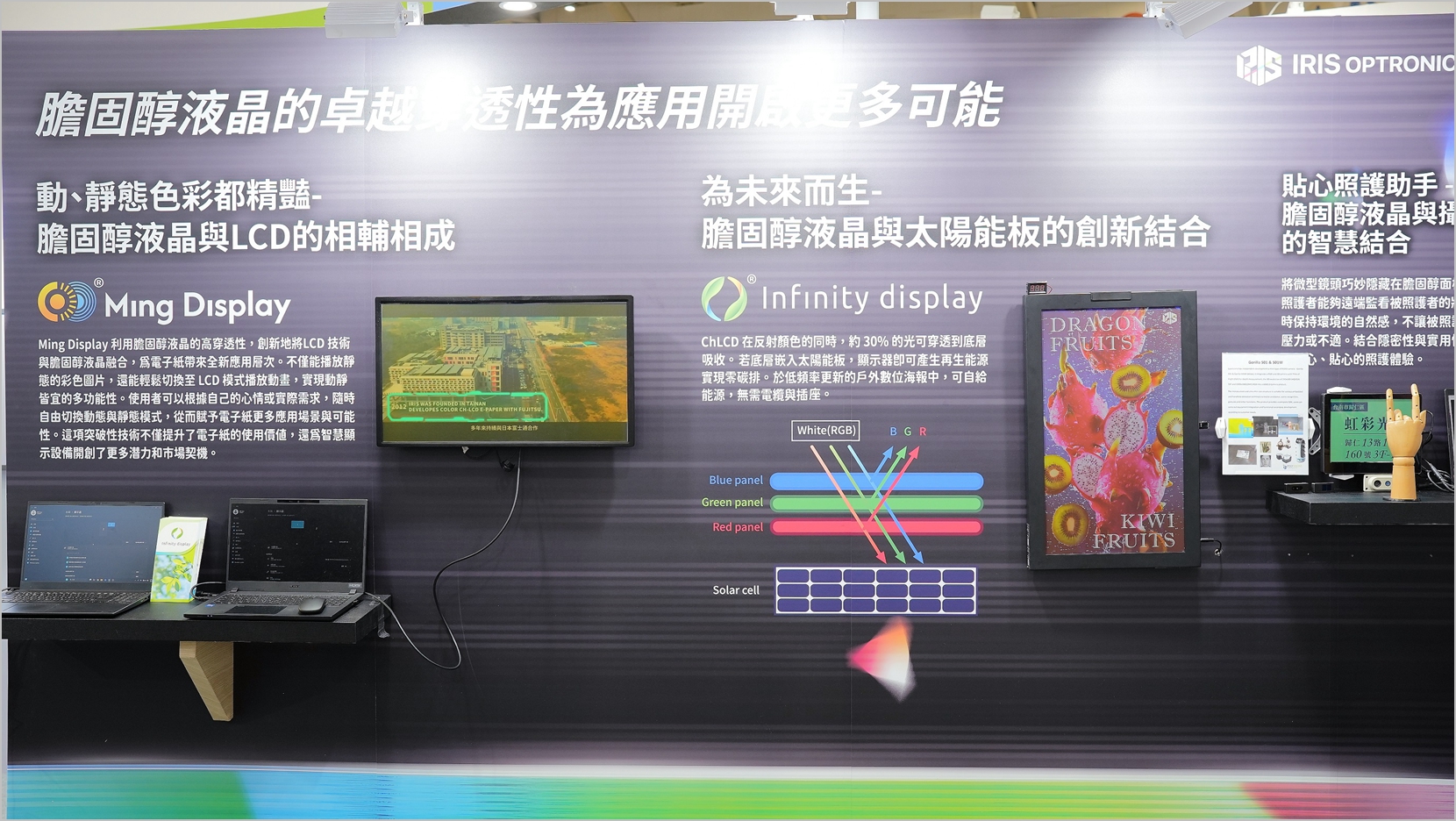
With its ultra-wide color gamut and innovative integrated technologies, Rainbow Optoelectronics continues to push the limits of ChLCD technology, further enhancing display performance. Its ultra-wide color gamut technology significantly improves display performance in bright light and indoor environments by increasing panel reflectivity and contrast. This not only enhances color performance but also effectively reduces energy consumption, achieving a perfect combination of display and energy saving, providing a superior visual experience. At this year's exhibition, Rainbow Optoelectronics showcased several innovative integrated technologies, including the world's first "Ming Display 2.0," which combines ChLCD with commercial LCD screens to achieve dual functions: an e-paper energy-saving mode and LCD animation playback. Another major innovation, "InfinityDisplay®," is a full-color, zero-power display with built-in solar power generation. This technology combines ChLCD with commercial solar panels, reflecting ambient light to display images and recovering light energy beyond visible wavelengths, converting it into electrical energy for storage. It requires no external power source or professional installation and is self-sufficient in sunny locations, demonstrating Rainbow Optoelectronics' strong capabilities in sustainable display technology.

The "InfinityDisplay®" is a full-color, zero-power display with built-in solar power generation, showcasing Rainbow Optoelectronics' strength in sustainable display technology. (Provided by Rainbow Optoelectronics)
On the other hand, ChLCD technology is also integrated with infrared photography technology (IR Camera). Through the high transmittance of ChLCD, a miniature lens is cleverly hidden in the display panel, allowing caregivers to remotely monitor the behavior of the person being cared for, while maintaining a natural atmosphere in the environment, avoiding psychological stress or discomfort, and providing a more reassuring and considerate care experience.

Rainbow Optoelectronics' cholesterol-based liquid crystal technology finds diverse applications – retail advertising. (Provided by Rainbow Optoelectronics)
Diverse application scenarios and large-size splicing modules drive a comprehensive upgrade in display technology. Rainbow Optoelectronics also showcased its large-size splicing module technology, specifically designed for scenarios requiring large display panels. This technology enables flexible splicing and wide-temperature outdoor operation, meeting the needs of smart cities and large-scale commercial advertising. This innovative technology foreshadows the further expansion of ChLCD technology's application scope and its key role in multiple fields. Furthermore, Rainbow Optoelectronics' full-color electronic paper technology has broken through the application limitations of traditional electronic paper, further expanding into diverse fields such as medical aesthetics, smart buildings, and smart retail. Its high-definition display effect can present extremely realistic skin texture, makeup layers, and high-quality printing effects, greatly enhancing the user's visual experience. These expanded application scenarios not only demonstrate the broad application prospects of Rainbow Optoelectronics' technology but also highlight its innovative leadership in the display industry.

The ultra-wide color gamut performance of cholesteric liquid crystals heralds a new era for color electronic paper. (Provided by Rainbow Optoelectronics)
Driving an ESG Vision and Creating a Sustainable Display Future: The innovative technologies showcased by Rainbow Optoelectronics at Touch Taiwan 2025 signify the company's leading position in the global display industry. Moving forward, Rainbow Optoelectronics will continue to focus on technological innovation, promoting the application of ChLCD color e-paper in more fields, and working with industry partners to achieve a smart, green, and efficient display future. Rainbow Optoelectronics' goal is not only to drive the development of display technology but also to dedicate itself to realizing a smart ESG vision and contributing to the sustainable development of the global display industry.