On July 20, Tesla's first "Supercharger Diner" officially opened for trial operation in Los Angeles, including a Hollywood-style restaurant and a Supercharger station. Most notably, the Supercharger station features two 45-foot LED drive-in theater screens, integrating LED cinematic displays with the charging service.

Image source: Elon Musk's media account
The Tesla Supercharger restaurant features 80 V4 Supercharger stations and two LED cinema screens playing movies and videos that can be synchronized with the speakers inside the Tesla vehicles. Additionally, owners can order food directly from the screens inside their Teslas; the menu includes fast food such as burgers, fries, chicken wings, hot dogs, milkshakes, and sandwiches.
This restaurant was conceived by Tesla CEO Elon Musk in 2018. Its design is inspired by 1950s drive-in restaurants, incorporating retro elements such as a large movie screen, roller-skate waiters, and a classic menu. At the event, you can also see Tesla's Optimus Prime humanoid robot working as a waiter, selling popcorn.
Diverse and Innovative Applications of LED Cinema Screens
As an emerging projection technology, LED cinema screens have seen accelerated penetration and development in recent years, gradually moving beyond the single scenario of traditional cinema projection and expanding to a wider range of applications, such as the Tesla charging restaurant mentioned above.
Traditionally, charging stations primarily provide electric vehicles with on-the-go charging. However, Tesla has transformed charging stations into experience centers that integrate charging, dining, and entertainment by introducing LED cinema screens. While waiting to charge, car owners can watch movies and videos on the LED cinema screens, enriching their waiting time.
LED cinema screens are also being applied in the cultural and tourism sector. For example, Unilumin Technology is exploring the application of dome theaters and has implemented related projects at the Mawangdui Museum in Changsha, Hunan, and the Riyadh Season carnival in Saudi Arabia.
Another example of cross-industry integration is Shenzhen's first "light show + 4K LED giant screen hall," which opened on June 21 at Prince Bay K11. The LED cinema, with technical support provided by Unilumin Technology, also opened simultaneously. On the opening day, the ceremony was held directly in the LED cinema, covering media releases, guest interactions, and multimedia presentations.
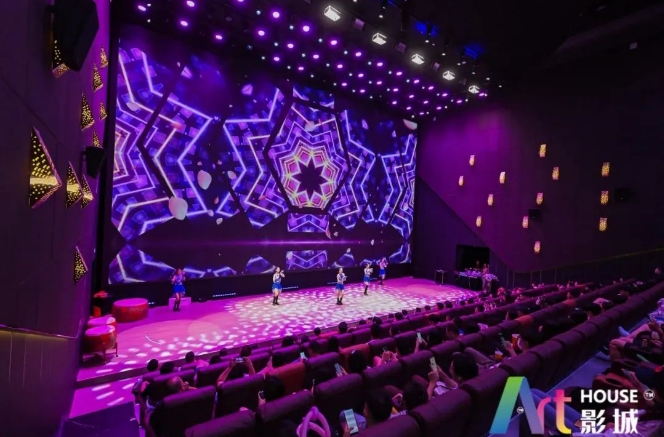
Image source: Unilumin Technology
As LED cinemas "go global," more and more content is also "entering" them. Live broadcasts of events in fields such as gaming and sports are gradually being brought into LED cinemas, allowing audiences to have a more immersive and interactive experience in a large-screen environment.
Taking Huaxia Liad as an example, on June 25 this year, the Huanying Island 4K LED Cinema Space introduced the professional football match "Chinese Super League" to the cinema for the first time for simultaneous live broadcast. The project broke through the technical barrier of adapting the live broadcast signal to the cinema standard, achieving smooth synchronization of the picture and lossless restoration of the sound effect, allowing the audience to enjoy the visual experience brought by the LED cinema.

Image source: Leyard
In the future, the Huaxia Liad Huanying Island LED cinema spaces across the country will simultaneously launch their viewing plans. As of the end of June 2025, 23 Huanying Island 4K LED cinema spaces have been established nationwide, which is expected to further promote the development of "cinema + sports".
In the esports live streaming field, the 2025 MSI League of Legends Heartfire Championship Finals concluded on July 13th. The event was simultaneously broadcast live in multiple VLED LED cinemas, providing viewers with an ultra-clear viewing experience. It is understood that the VLED LED cinema screens were launched by China Film Optics, and have already been installed in more than 20 cinemas nationwide.
Why can LED cinema screens unlock applications in multiple scenarios?
The reason why LED cinema screens can move beyond traditional cinemas and unlock more diverse applications stems from multiple factors.
From a technical perspective, the rapid maturation of LED technology and the continuous reduction in cost are key reasons for its application development. LED cinema screens boast higher brightness, contrast, and color performance, enabling them to clearly present image content. High refresh rates and low latency ensure smoothness and real-time performance when playing highly dynamic content such as games and sports events.
For example, the 2025 MSI League of Legends finals were broadcast live in a VLED LED cinema because LED cinema screens have advantages in brightness, contrast and viewing angle, which can present game details and dynamic scenes more clearly.
In addition, the breakthrough in LED sound-permeable screen technology has solved the problem that early LED screens could not transmit sound. China Film Technology, Lopu, and Unilumin Technology have launched fully sound-permeable screen products, allowing viewers to enjoy an immersive movie-watching experience that integrates visual and sound effects.
On the corporate side, Leyard is focusing on "cinema + sports", Unilumin is promoting the application of LED cinema screens in cultural tourism and commerce, and China Film Optics is focusing on "cinema + gaming". Sports leagues and game event organizers have also seen the value brought by LED cinema screens and are expected to jointly promote the development of the industry.
At the policy level, the national and local governments have introduced relevant support measures. Just recently, the National Film Administration issued another notice on the development and standardization of digital cinema LED theaters, which means that domestically produced LED cinema screens are expected to enter an era of higher-quality development.
Looking ahead, the market for LED cinema screens is enormous. Analysts believe that there are currently over 200,000 cinema screens globally, including more than 30,000 high-end screens. These high-end screens are expected to be replaced by LED cinema screens in the future, and LED cinema screens are also expected to be applied in more diverse scenarios. (Text: Mia)