Recently, a research team at the University of Rochester announced the development of a novel optical component based on metasurfaces, which can significantly improve the image brightness and clarity of AR glasses, paving the way for lightweight and energy-efficient AR devices. The relevant results were published in the academic journal Optical Materials Express.
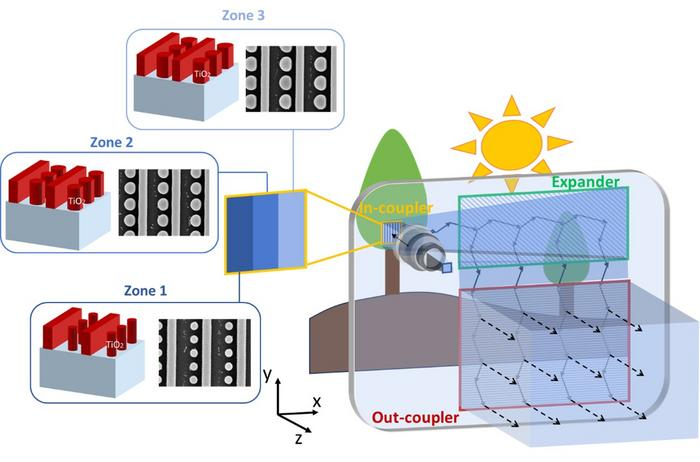
Image source: University of Rochester, USA
Nickolas Vamivakas, the research team leader, stated that most current AR glasses are bulky, lack sufficient brightness, and have limited battery life, making them particularly difficult to display clearly in outdoor environments. The team's new research, by optimizing the light input (waveguide coupler), effectively improves brightness and energy efficiency, making AR glasses feel more like wearing regular glasses.
Traditional AR waveguide couplers often result in dim images due to light loss. Therefore, the team redesigned the input coupler using metasurface technology, dividing it into three functional sections, each composed of nanoscale structures, to efficiently guide and control incident light. The metasurface is only one-thousandth the thickness of a human hair, enabling light manipulation capabilities unattainable by traditional optical components.
In the experiment, researchers used precision processes such as electron beam lithography and atomic layer deposition to fabricate samples and tested them in a self-built optical system. The results showed that the average optical coupling efficiency of the new design reached 30% within a horizontal field of view range of -10° to 10°, which is highly consistent with the simulated value of 31%, verifying the practicality and stability of the design.
In the future, the team plans to extend this design to the entire waveguide system, aiming for full-color display and improving manufacturing processes to enhance yield and consistency. Researchers point out that commercialization requires integrating the coupler with an actual microdisplay engine and developing a low-cost mass production process.
This achievement demonstrates the enormous potential of metasurface optics in next-generation AR displays, and is expected to address the current bottlenecks in brightness, power consumption, and user comfort. (Source: University of Rochester, compiled)