Over the past year, the application prospects of Micro LED technology in both display and non-display fields have remained bright. Although technical challenges such as chip efficiency, full-color technology, and mass transfer, as well as production costs, still exist, significant progress has been made this year: in the display field, Micro LED continues to penetrate diverse scenarios such as commercial displays, automobiles, and AR/VR; in the non-display field, Micro LED is further exploring high-growth scenarios such as optical communication.
According to the latest report, "2025 Micro LED Display and Non-Display Application Market Analysis," the development focus of Micro LED in display applications lies in reducing costs through optimization of design and production processes, while simultaneously exploring niche markets that align with its characteristics, such as transparent displays, automotive HUDs, and AR/VR. In addition, Micro LED is gradually unlocking new opportunities in non-display applications. Benefiting from its miniaturization and arraying characteristics, Micro LED can be used for information transmission, surface excitation, absorption, curing, and dissociation, creating more possibilities for the medical, sensing, and optical communication fields.
As Micro LED demonstrates its potential in more fields, related manufacturers are either accelerating their investment in technology research and development, concentrating their resources on it, or strengthening industry collaboration in order to be fully prepared to seize business opportunities. Recently, two manufacturers have announced their relevant development plans and progress.
Titan Intech plans to invest approximately 200 million yuan to build a display electronics factory in India.
On November 17, it was announced that Indian technology company Titan Intech Limited has signed a 2.5 billion rupee (approximately 201 million yuan) memorandum of understanding with the Andhra Pradesh Economic Development Board to build an advanced integrated display electronics manufacturing plant in the Amarawati capital region. The 20-acre plant will focus on the research and development of high-value display controllers, intelligent drive systems, 2D/3D rendering engines, and Mini/Micro LED modules.

Titan Intech has reportedly made building India's next-generation display electronics ecosystem a long-term development strategy, and this factory construction project is a key step in implementing that strategy. The project is expected to create 200 direct jobs and over 300 indirect jobs.
Titan Intech stated that this move will accelerate technology transfer, strengthen India's local supply chain, support India's "Atmanirbhar Bharat" self-reliance strategy, help India reduce its import dependence, and enhance its competitiveness in high-tech electronics exports.
CEA-Leti launches multilateral cooperation plan for Micro LED optical data links
On November 18, at the SEMICON Europa conference in Munich, CEA-Leti of France announced the launch of a three-year multilateral cooperation project focusing on the application of Micro LED in ultra-high-speed short-range optical interconnects. The project, scheduled to officially launch in January 2026, is intended to be open to Micro LED suppliers, fiber optic manufacturers, photodiode manufacturers, chip manufacturers, system integrators, and hyperscale cloud service providers.

Image source: CEA-Leti
CEA-Leti CEO Sébastien Dauvé pointed out that with the computing power required for AI model training doubling every three to four months, traditional copper-based and laser interconnect technologies are struggling to meet the requirements of high speed, low latency, and low power consumption. Micro LED, with its small size, high switching modulation rate (several Gbps), and energy efficiency advantages (lower power consumption than copper-based and 100 times more reliable than existing optical links), is considered a breakthrough solution to the interconnect bottleneck.
Against this backdrop, CEA-Leti launched the project. The project plans to leverage CEA-Leti's 15 years of experience and nearly 100 patents in Micro LED technology to propel Micro LED from the laboratory to commercial mass production, with the goal of achieving massively parallel communication and significantly reducing the power consumption and density limitations of next-generation computing systems.
summary
The development of Micro LED technology has entered a fast track, and its application boundaries are constantly expanding. Combining the developments this year and the development plans of the aforementioned companies, it is not difficult to see that two major development paths for the Micro LED ecosystem are gradually becoming clear.
On the one hand, in display applications, Micro LED is gradually demonstrating enormous commercial potential in areas such as AR/VR, automotive displays, and ultra-large-size displays, and its commercialization process is accelerating significantly. From a regional development perspective, with the global landscape of the new display industry still uncertain, different regional markets are all hoping to strengthen their local advanced technology industries to gain more initiative. Titan's investment reflects the Indian market's determination to localize and industrialize next-generation display technologies such as Micro LED.
On the other hand, the application of Micro LED in non-display fields such as optical interconnects is attracting global attention and anticipation. Microsoft's previously released "MOSAIC" optical link technology report validated the advantages of Micro LED, while the CEA-Leti collaboration also highlights the important role of Micro LED in the AI computing era...
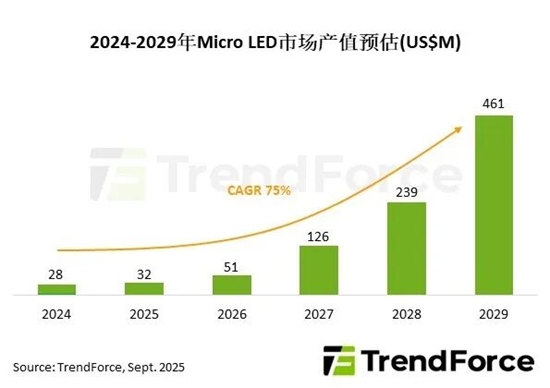
In summary, Micro LED technology is rapidly moving from the laboratory to industrialization, with global R&D collaborations and investment becoming increasingly sophisticated. Analysis suggests that although the overall LED market growth will slow in 2025 due to macroeconomic factors, niche sectors such as Micro/Mini LED will maintain growth momentum. Non-display and transparent/automotive markets will be key drivers, with the Micro LED chip market value projected to reach US$461 million by 2029. (Text: Janice)


