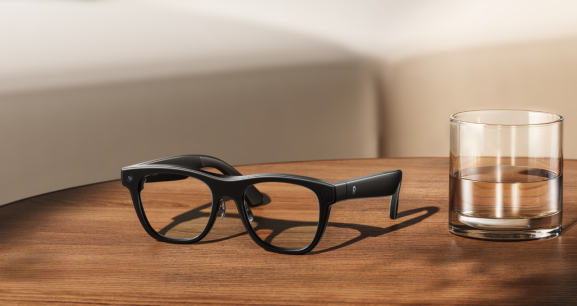
Recently, there has been a flurry of news in the global AR/AI glasses industry: the British military has deployed an AR remote support system in its cloud infrastructure; Chinese company Weiche Technology has released smart glasses specifically designed for gas stations as "digital employees"; and Quark AI Glasses has announced a partnership with Alipay to upgrade its payment functions.
Despite their diverse applications, AR/AI glasses are shedding their label as mere technology toys, moving beyond simply watching movies and playing games to become productivity tools capable of solving real-world problems.
Near-eye devices are moving from entertainment to practical use . In the past, the near-eye display industry focused primarily on entertainment scenarios such as gaming and movie watching. However, recent application cases show that the value of this technology in B2B vertical sectors and high-frequency C2C tool scenarios is being deeply explored.
In the defense and industrial sector, according to the latest announcement from the UK government's Defence and Security Accelerator (DASA), Kognitiv Spark, a provider of industrial mixed reality and augmented reality mission support solutions, has officially deployed its augmented reality remote support system on the UK's sovereign defense cloud infrastructure.

Image source: Kognitiv Spark
The RemoteSpark platform connects frontline technicians, engineers, and remote experts via AR headsets. In environments such as workshops, warehouses, or the field, users can share audio and video in real time, access technical documents, and receive remote annotations and step-by-step instructions. According to government announcements, the British Army plans to promote the technology's trial among a wider user base to validate RemoteSpark's feasibility in various support and maintenance scenarios.
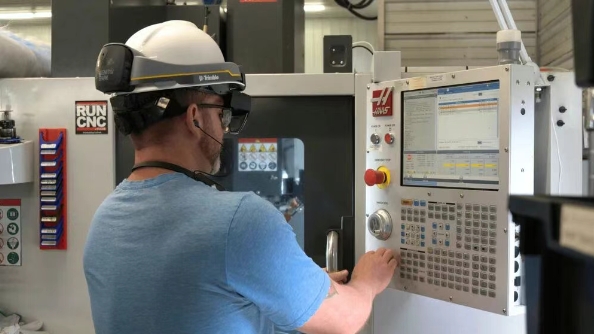
Image source: Kognitiv Spark
In the civilian and commercial sector, AR glasses are evolving into tools to improve employee efficiency. On November 20th, Weiche Technology released smart glasses for gas stations. This device collects data through a camera and combines it with a large-scale AI model in the background to complete license plate recognition and member matching within seconds, and then pushes standardized service scripts to employees. This "digital employee" model proves that the combination of AR and AI can be embedded in specific industry operations, creating commercial value by increasing standardization.
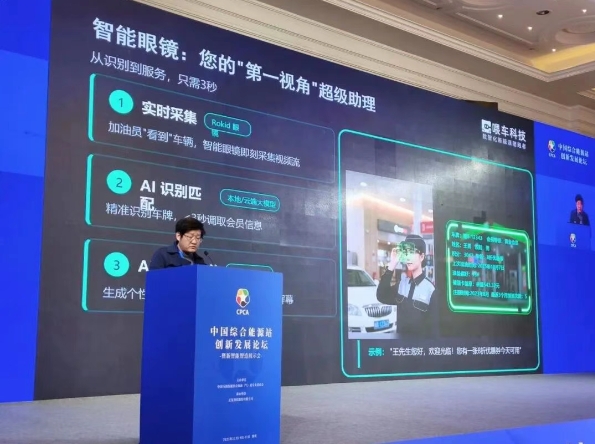
Image source: Weiche Technology
In the consumer market, on November 20th, it was announced that Quark AI Glasses and Alipay have achieved a significant upgrade in their cooperation. Building on the original "pay with a glance" function, new innovative capabilities such as crosshair-assisted focusing and bone conduction voice pickup have been added. These upgrades will improve the accuracy and convenience of QR code payments, bringing users a safer and more efficient payment experience.
Simplification and lightweighting have become an industry consensus . However, to support the aforementioned productivity scenarios and achieve all-day wearability and assistance, the hardware form factor needs to change. In the past, AR glasses design often fell into the trap of trying to have everything, resulting in devices weighing over 200 grams, short battery life, and a poor user experience.
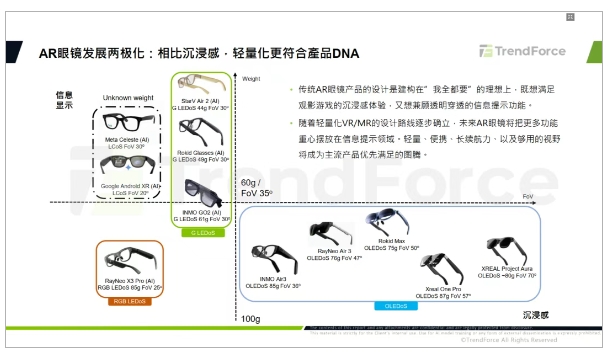
According to Chiu Yu-pin, Senior Vice President of Research at TrendForce, the industry consensus in 2025 has shifted. With the gradual establishment of lightweight VR/MR design principles, future AR glasses will place more emphasis on information display. Lightweight design, portability, long battery life, and sufficient field of view will become the primary priorities for mainstream products.
Within this design framework, the appearance and wearing experience of auxiliary information AR glasses should closely resemble traditional glasses, making weight reduction a top priority. Qiu Yubin believes that the weight of the next generation of AR glasses should be controlled below 60 grams to ensure wearing comfort. Simultaneously, the field of view should be narrowed to 20 to 30 degrees, a range that meets the needs of information prompts while also helping to control the cost of the optical and display systems.
This viewpoint aligns with recent rumors surrounding Samsung. Reports indicate that Samsung is developing two smart glasses models, expected to launch in 2026 and 2027 respectively. Early versions may lack complex AR display capabilities, focusing instead on AI voice interaction and a lightweight user experience. This reflects the tech giants' rational assessment of technological maturity.
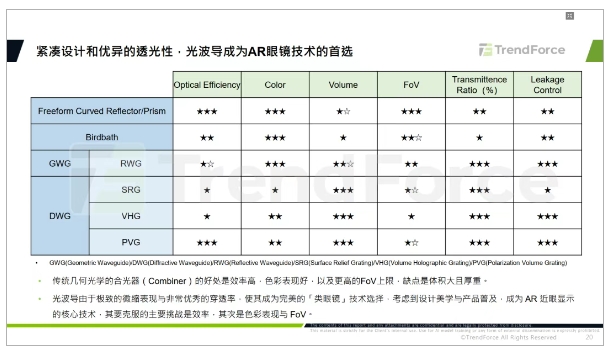
Optical waveguides are key to lightweight AR glasses . In the path to achieving lightweight and glasses-like designs, Qiu Yubin points out that optical waveguides, due to their extreme miniaturization and excellent transmittance, are the perfect technology choice for "glasses-like" designs. Currently, diffractive waveguides are the most popular and widely used, mainly processed through nano-pressing and photolithography, and these methods will coexist in the future. However, Meta's AR prototype Orion uses SiC waveguides paired with double-sided gratings, opening up possibilities for the use of new materials and attracting widespread attention to SiC waveguide technology within the industry.
It is worth noting that in this cutting-edge materials field, the global industrial chain is shifting towards China. Qiu Yubin further pointed out that, currently, in terms of industrial chain distribution and production capacity, the main players in SiC optical waveguides are Chinese market manufacturers. There is a growing trend of SiC suppliers, optical waveguide companies, and brands in the Chinese regional market forming alliances. This upstream and downstream cooperation in materials and the supply chain is conducive to rapidly driving down the cost of SiC optical waveguides.
summary
In 2025, the industry consensus shifted from pursuing parameter stacking to achieving ultimate lightweighting and practical applications. In this transformation, optical supply chain technologies, including diffractive waveguides and SiC waveguides, are becoming key forces in overcoming physical bottlenecks and driving cost reductions. With the development of product forms and breakthroughs in core materials, AR/AI glasses are expected to see further development in the upcoming year of 2026.
To further explore the future landscape of AI hardware, the “MTS2026 Storage Industry Trends Seminar” will be held on Thursday, November 27, 2025, at the Raffles Hotel Shenzhen. At the seminar, Qiu Yubin, Senior Vice President of Research at TrendForce, will deliver a keynote speech entitled “Experience Revolution: The Future Path of AI Headsets,” providing an in-depth analysis of industry opportunities and technological evolution. All industry colleagues are welcome to attend and exchange ideas. (Text: Mia)