Recently, HKC released its first monitor product using an RGB-Mini LED backlight solution, the HKC M10 Ultra, marking the further extension of RGB-Mini LED technology from large-screen TVs to the field of small and medium-sized monitors.
From a technical perspective, RGB-Mini LED differs from traditional solutions that use white backlighting and color filters to achieve color display. Instead, it directly uses red, green, and blue Mini LED chips as the backlight source, achieving display through independent control of the brightness of the three primary colors. This approach reduces spectral loss, improves luminous efficiency, and offers advantages in brightness and power consumption control.
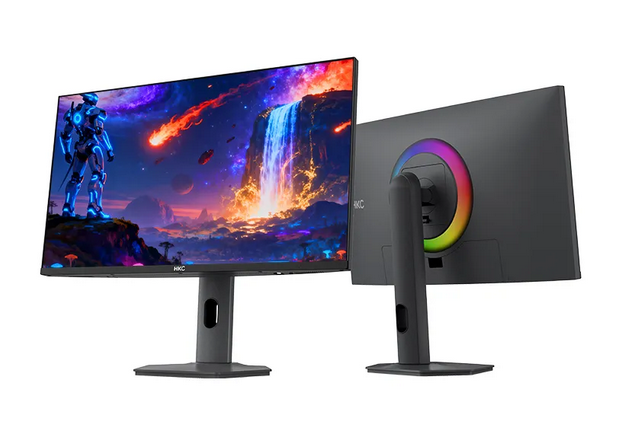
Image source: HKC
In terms of specifications, the HKC M10 Ultra features a 31.4-inch panel that supports dual display modes of 4K 165Hz and FHD 330Hz, and uses an RGB-Mini LED backlight system with 4788 light-controlling zones.
Official data shows that it covers four major color gamuts: sRGB, DCI-P3, Adobe RGB, and BT.2020. Color management supports 3D LUT calibration, and ΔE is less than 1 in some modes. In terms of brightness, the product is rated at approximately 1000 nits full-screen brightness, with a peak brightness of up to 1600 nits, and supports multiple HDR curve standards.
In terms of interface and structural design, the M10 Ultra offers HDMI 2.1, DP 2.1, and a full-featured Type-C port supporting 98W power delivery, meeting the connectivity needs of high refresh rate gaming and professional content creation. The stand supports ergonomic adjustments such as height and rotation, and the base adopts a compact structure to reduce desktop space occupation.
According to public information, HKC has long focused on the semiconductor display field, with its main business covering the research and development and manufacturing of core display devices such as semiconductor display panels, and extending to smart display terminals. Currently, the company has deployed multiple display technologies, including a-Si TFT-LCD, Oxide TFT, Oxide RGB OLED, Oxide LCD, and Mini LED.
In the MLED field, HKC simultaneously promoted the construction of three key projects in the first half of this year, including the Mianyang HKC Mini LED Phase I Project, the Hunan Changsha Mini LED Backlight and Direct Display Module and Complete Machine Project, and the Dongguan Flat Panel Display Phase II Project, with a total investment of approximately RMB 14.76 billion.
On the product side, at the DIC exhibition held in August this year, HKC showcased several Mini LED backlit TVs, including a 116-inch 4K ultra-thin wallpaper TV and a 116-inch RGB Mini LED backlit TV jointly developed with Hisense.
Financial data shows that from 2022 to 2024, HKC's revenue was RMB 26.965 billion, RMB 35.824 billion, and RMB 40.282 billion, respectively; net profit attributable to the parent company was RMB -1.421 billion, RMB 2.582 billion, and RMB 3.32 billion, respectively. In the first half of 2025, the company achieved revenue of RMB 18.997 billion and net profit attributable to the parent company of RMB 2.162 billion.
Regarding IPOs, on November 28th, the Shenzhen Stock Exchange disclosed that HKC Corporation had submitted supplementary financial materials, and its IPO review had been reinstated. In June of this year, HKC's IPO application was accepted by the Shenzhen Stock Exchange, with a planned fundraising of 8.5 billion yuan. The funds will be used for the Changsha New OLED R&D and Upgrade Project, the Changsha Oxide R&D and Industrialization Project, and the Mianyang Mini LED Intelligent Manufacturing Project. (Compiled)


