On December 10, a joint research team from the Korea Advanced Institute of Science and Technology (KAIST) and the Ulsan National Institute of Science and Technology (UNIST) announced the successful development of a flexible 3D Micro LED device that can be implanted in the body, providing a novel treatment option for pancreatic cancer and demonstrating significant efficacy in animal experiments. The research findings have been published in the academic journal *Advanced Materials*.
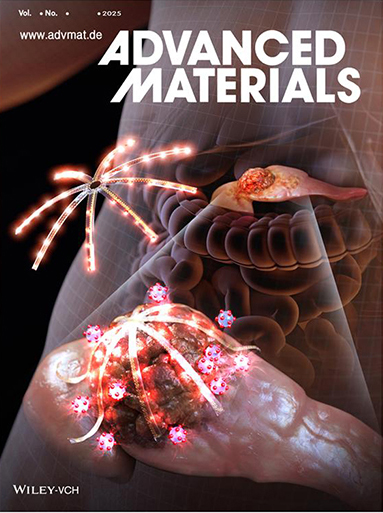
Image source: Advanced Materials
It is understood that pancreatic cancer is difficult to cure due to its complex tumor microenvironment. Pancreatic cancer tumors are typically surrounded by a dense fibrotic biological barrier, resulting in extremely high internal pressure and a lack of blood vessels, which severely hinders the penetration of chemotherapy drugs and immune cells.
Although photodynamic therapy (PDT) is considered a promising treatment, traditional phototherapy devices often face thorny problems such as light not being able to penetrate deep tissues, easily causing thermal damage to surrounding healthy organs, and triggering inflammation.
To address these issues, Professor Keon Jae Lee's team at KAIST and Professor Tae-Hyuk Kwon's team at UNIST collaborated to develop a flexible Micro LED phototherapy device that resembles an octopus.
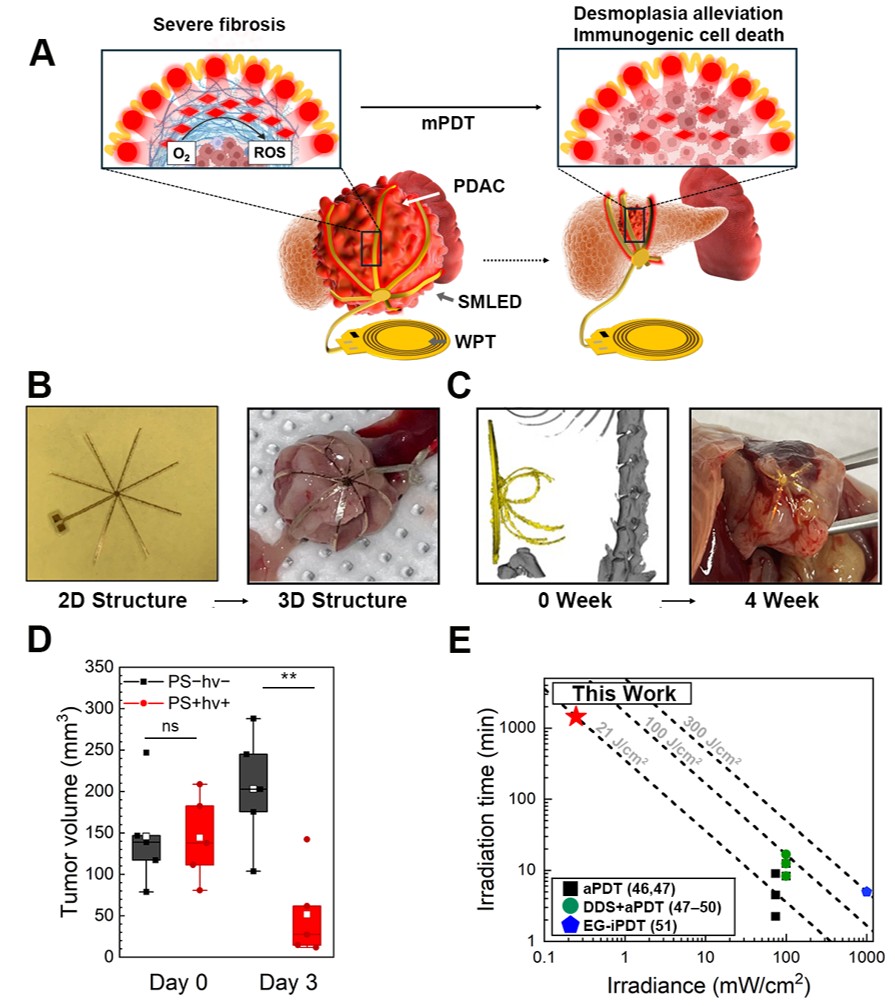
Image source: Advanced Materials
The device maintains a two-dimensional structure before implantation, but once implanted, it can automatically deform into a three-dimensional structure according to the shape of the pancreas, tightly wrapping the entire tumor like octopus tentacles.
This design solves the problem of traditional rigid devices being unable to adhere to soft tissue. Regardless of whether the pancreatic tumor expands or contracts during physiological processes, the device can always maintain a close fit, ensuring continuous and uniform delivery of low-intensity light energy to deep tissues.
This low-intensity light stimulation can precisely activate photosensitizers to kill cancer cells, while effectively avoiding the thermal damage that high-intensity lasers may cause, thus protecting the surrounding normal tissues to the greatest extent.
Experiments in mice showed that within just three days of treatment initiation, the dense fibrous tissue surrounding the tumor decreased by 64%. More importantly, with this continuous photodynamic therapy, the diseased pancreatic tissue successfully reversed and reverted to its normal morphology. During the four-week observation period, the device maintained stable adhesion without detachment, fully demonstrating its potential in disrupting the tumor microenvironment.
Professor Keon Jae Lee revealed that the team's next plan is to combine this Micro LED technology with an artificial intelligence (AI) platform to develop an intelligent medical system that can monitor tumor status in real time and provide personalized treatment plans.
Professor Tae-Hyuk Kwon of UNIST also pointed out that this technology not only solves the problem of phototherapy's inability to reach deep tissues, but also lays the foundation for future development of immunotherapy combinations for other refractory cancers. (Source: Advanced Materials, compiled)