Recently, a research team from Xiamen University and the Xiamen Future Display Technology Research Institute has made a significant breakthrough in the field of Micro-LED research, and the relevant research results were published as a cover article in the journal Advanced Optical Materials.
The team proposed a novel method for sidewall passivation of nitride Micro-LEDs, utilizing light ions to perform atomic-level electronic state modification and passivation of nitride sidewalls. The research team delved into the evolution mechanism of the atomic configuration of nitride device sidewalls and the impact of sidewall reconstruction on defect states. Based on electronic state passivation theory, they developed a new method for hydrogen atom passivation of sidewalls, which can effectively suppress sidewall damage and its negative impact on device performance.
This innovative technology has enabled the successful fabrication of a 5 μm blue Micro-LED device with a wave-to-optical conversion efficiency (WPE) of up to 36.9%. This research provides a reliable technical solution for improving the performance of nitride Micro-LEDs and lays the foundation for the future development of display technologies.
Research Background
Micro-LED technology, as the core of next-generation display technology, is developing towards higher resolution, lower power consumption, and longer lifespan. However, with the reduction in device size, sidewall damage caused by manufacturing processes such as dry etching has become a major problem limiting the luminous efficiency of Micro-LEDs. Existing surface treatment technologies have alleviated the sidewall damage effect to some extent, but the defect evolution process remains unclear. Therefore, a deeper understanding of the sidewall defect evolution process and the development of novel passivation technologies are crucial for improving the performance and stability of GaN-based Micro-LEDs.
Research Content <br /> This study revealed the evolution of sidewall electronic states and carrier recombination mechanisms in Micro-LEDs through DFT calculations, particularly the influence of dangling bonds and oxygen impurities on the electronic structure of GaN sidewalls. The study found that hydrogen atom adsorption on the sidewalls effectively eliminates surface band bending and defect electronic states caused by dangling bonds. Simultaneously, hydrogen atoms react with adsorbed oxygen impurities on the sidewalls to form stable -OH complexes, thereby eliminating deep-level defects introduced by oxygen impurities. This indicates that hydrogen atom adsorption not only passivates and repairs sidewall defects but also acts as a barrier and protector, preventing oxygen atoms from re-contaminating the sidewalls during manufacturing. This holds promise for optimizing the sidewall surface electronic structure, reducing non-radiative recombination, and improving the stability of Micro-LEDs.
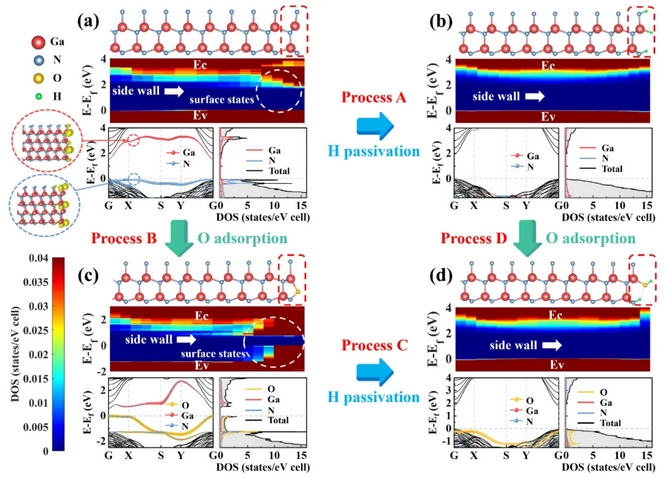
Figure 1. Schematic diagrams of the (10-10) facet sidewalls and electronic structures with different surface configurations.
Building upon the aforementioned research, the team developed a lightweight ion-repair passivation technique, employing hydrogen plasma treatment on the device sidewall surface after wet etching. Results showed that after wet etching removes damage caused by dry etching, O adsorption significantly impacts the device's photoelectric performance. Hydrogen plasma treatment, however, restores the electronic structure of the O-contaminated regions and effectively passivates the exposed sidewalls, suppressing nonradiative recombination and significantly improving PL intensity. These experimental results are consistent with theoretical calculations, validating the crucial role of hydrogen passivation in improving and protecting Micro-LED performance.
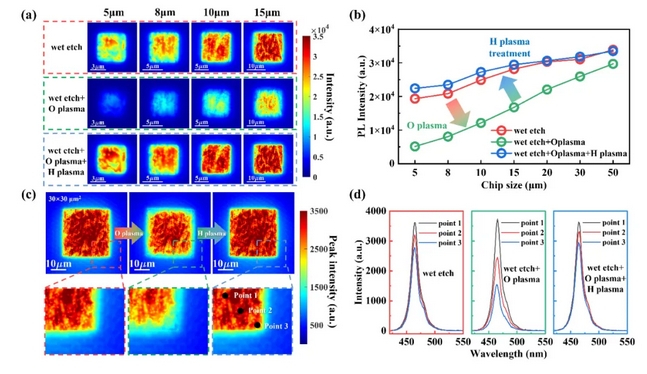
Figure 2. The effect of O impurities on the sidewalls of Micro LEDs and the reduction and repair effect of H passivation on O impurities.
Based on the lightweight ion repair and passivation technology, the team has significantly improved the performance of GaN-based blue Micro-LEDs of different sizes, exhibiting a "reverse size effect," that is, the peak current density (WPE) increases as the size decreases, with the WPE of the 5 μm device increasing significantly from 15.3% to 36.9%; at the same time, the peak current density of devices of all sizes is less than 5 A/cm2.

Figure 3. Photoelectric properties of Micro LEDs fabricated using lightweight ion-modified passivation technology
Research Background <br /> This work was completed by the team of Academician Zhang Rong from Xiamen University and Xiamen Future Display Technology Research Institute. Yan Jinjian, a doctoral student from the School of Physics Science and Technology, is the first author of the paper. Associate Professor Lu Weifang, Professor Li Jinchai, and Professor Huang Kai from the School of Physics Science and Technology/Xiamen Future Display Technology Research Institute are the co-corresponding authors. This work was supported by the National Key Research and Development Program of China (2022YFB3603604), the National Natural Science Foundation of China (62404184, 62174141), the Fundamental Research Funds for the Central Universities (20720230019), and the Xiamen Municipal Science and Technology Key Program (3502Z20231048). (Source: Xiamen Future Display Technology Research Institute)


