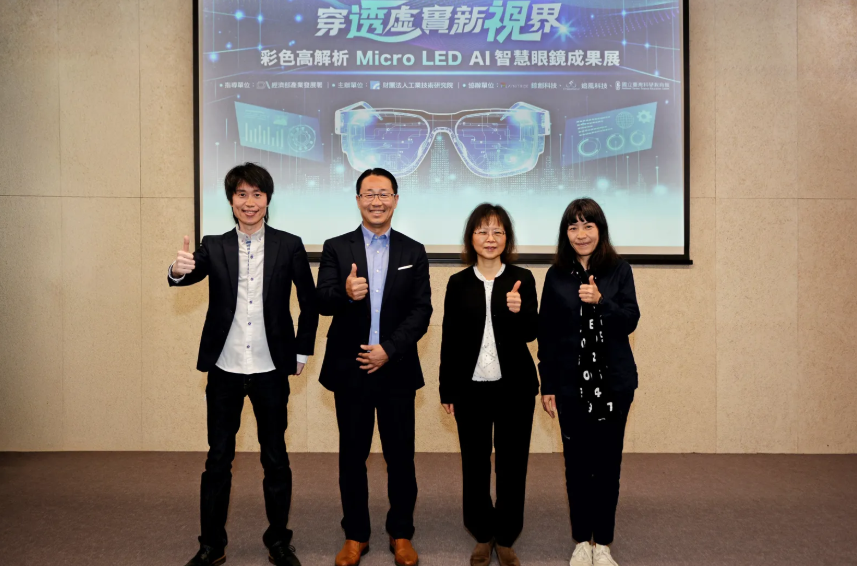
The Industrial Technology Research Institute (ITRI) announced today (10th) that, with the strong support of the Industrial Development Administration of the Ministry of Economic Affairs, ITRI has integrated next-generation display technologies combining AI and 5G, collaborating with Nexcom Display Technology and Chasing Technology to create Taiwan's first "Color High-Resolution Micro LED AI Smart Glasses." A results presentation was held at the Semiconductor Future Hall of the National Taiwan Science Education Center to showcase the technology's highlights and application scenarios to the public. Due to its ultra-high resolution, high brightness, and low power consumption, the glasses offer six times the image detail and five to ten times the brightness of commercially available products, and can even be used in sunlight. It is expected to pioneer new applications in the field of smart education and significantly enhance the public's immersive audiovisual experience.
Chang Shih-chieh, Director of the Electronics and Optoelectronic Systems Research Laboratories at ITRI, stated that the Augmented Reality (AR) and Virtual Reality (VR) industries are rapidly emerging in fields such as gaming, entertainment, education, tourism, retail, and healthcare. ITRI, with its long-standing expertise in Micro LED technology research and application, has partnered with leading Micro LED manufacturer Nextech Display Technology and AR glasses manufacturer Windlink Technology to accelerate the deployment and verification of AR smart glasses. This collaboration has resulted in Taiwan's first "Color High-Resolution Micro LED AI Smart Glasses," achieving both ultra-high image quality and high brightness, giving AR devices excellent display effects. By combining AI and AR functions, digital information is overlaid on the real world, creating more intelligent interactions and applications. These glasses can be further applied in fields such as healthcare, education, and industrial manufacturing to provide real-time assistance and guidance, improve work efficiency and accuracy, and ultimately enhance service efficiency while providing an engaging and educational experience. ITRI hopes that this collaboration with industry partners will drive technological innovation and breakthroughs, leading to the vigorous development of smart wearables and the metaverse.
Lee Yun-li, Chairman of Nichuang Display Technology, stated that most AR/VR smart glasses on the market currently use microdisplay technologies such as OLED or LCoS. While OLED offers excellent color performance, it still suffers from drawbacks such as insufficient brightness and burn-in, limiting its use to indoor or shaded environments and failing to meet the needs of outdoor scenarios. LCoS, on the other hand, suffers from insufficient contrast, limited brightness, and difficulties in miniaturization. Micro LED technology boasts peak brightness and contrast far exceeding those of OLED and LCoS, maintaining clear and vibrant images even in bright outdoor light, while avoiding burn-in and lifespan degradation issues. It can be said that in terms of brightness, image quality, and size, it comprehensively surpasses existing microdisplay solutions. This time, the Industrial Technology Research Institute's Opto-Electronics Laboratory integrated Nichuang Display Technology's 0.49-inch monolithic high-resolution color Micro LED microdisplay into AI smart glasses, potentially unlocking future applications and opportunities in smart education settings.
Su Yanzhang, CEO of Chasing Technology, explained that we are currently in a golden age where AI and AR technologies are both taking off. With the explosion of AI technology and the breakthrough in Micro LED display technology, a key component of AR, the application of AI+AR smart glasses has finally moved from concept to practical use. The development of AI Large Language Models (LLM) has infused AR smart glasses with the soul of a "super assistant"; while Micro LED technology has brought a ray of light to smart glasses, with high brightness solving the light efficiency limit of optical design and low power consumption overcoming the challenges of hardware size and weight. The future of smart glasses is promising because of these technological breakthroughs. Chasing Technology is honored to collaborate with ITRI and Neptunus Display Technology to jointly create Micro LED AI smart glasses, combining AI virtual human applications to allow the AI super assistant to be realistically presented to the user. Whether in a high-brightness indoor environment or a bright outdoor scene, the high-resolution color Micro LED display technology can perfectly present the AI virtual human. Chasing Technology will continue to delve into AI+AR technology, promote more innovative applications, and open a new chapter in smart wearables.
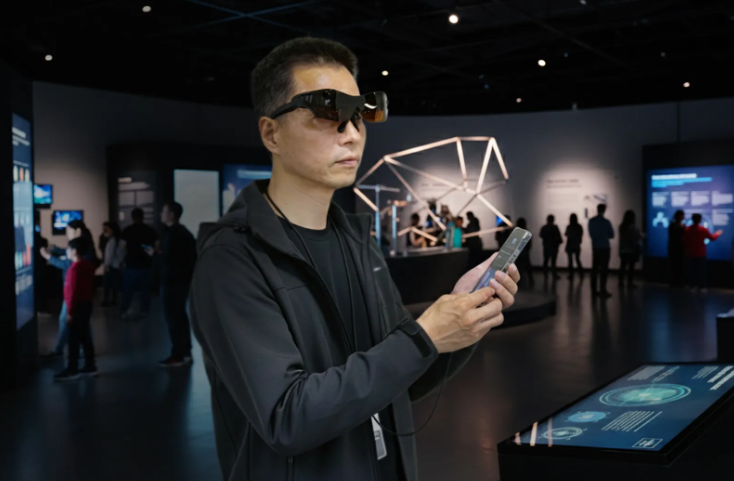
The "High-Resolution Micro LED AI Smart Glasses" boasts three main features. First, high resolution: It features ultra-high image quality (FULL HD, 1920 x 1080) and a pixel density of 4536 PPI, six times the detail of existing Micro LED AR glasses, providing users with a highly immersive metaverse display effect. Second, high brightness: With a brightness exceeding 3,000 nits, it meets the threshold for outdoor use and is five to ten times brighter than commercially available OLED AR glasses. It effectively combats strong light, allowing for comfortable use even in sunlight, breaking the limitation of existing products that can only be used indoors. Third, low power consumption: Power consumption is controlled below 1W, significantly improving battery life. Furthermore, it incorporates AI virtual guide technology, combining smart glasses with mobile phone voice functionality for real-time interaction with a virtual guide, providing rich color content for an entertaining and educational experience. In the future, it can be further applied in fields such as healthcare, education, and industrial manufacturing, providing real-time assistance and guidance, improving work efficiency and accuracy, and boosting industrial operational efficiency.